Sodium-Ion Battery for Biogas Plant: Cold-Weather Storage
Anaerobic digestion sites are usually remote, unheated and grid-constrained, which makes storage a practical problem rather than a theoretical one. The plant needs power to keep digester mixers and heating loops running when the grid is weak, and wants to shift its own generation into the hours when export prices are highest. Sodium ion battery chemistry is a strong fit for that duty because it is cheap at scale, tolerant of cold, and happy sitting at partial charge for long stretches without degradation.
What a Biogas Plant Stores Energy For
Three jobs dominate. The first is resilience: keeping the digester mixers, feed pumps and control system running through a grid outage, because a stalled digester can sour and cost weeks of gas output. The second is dispatch: charging when the CHP unit would otherwise run at part load, then discharging into the evening export peak. The third is parasitic load shaving, covering blowers and the heating loop during the expensive morning window instead of importing at peak tariff.
Why Sodium Suits Digester Sites
Sodium-ion cells use abundant iron, manganese and hard carbon rather than lithium, nickel and cobalt, so material cost is structurally lower and less exposed to price shocks. The chemistry also tolerates partial-state-of-charge operation: the bank floats near full most of the time and cycles shallowly when the CHP set is serviced. Cycle life of 3000 to 6000 cycles at 80 to 90 % depth covers a decade of that pattern comfortably.
Sodium vs LFP for Biogas Duty
| Attribute | Sodium-Ion | LFP (LiFePO4) |
|---|---|---|
| Capital cost per kWh | Lower | Medium |
| Performance at −20 °C | >90 % capacity, no heater | ~70 %, heater needed |
| Energy density | Lower (bigger footprint) | Medium |
| Cycle life | 3000–6000 | 4000–7000 |
| Supply-chain risk | Low | Medium |
| Cold-climate parasitic load | Minimal | Heater draws from the bank |
The Cold-Weather Argument
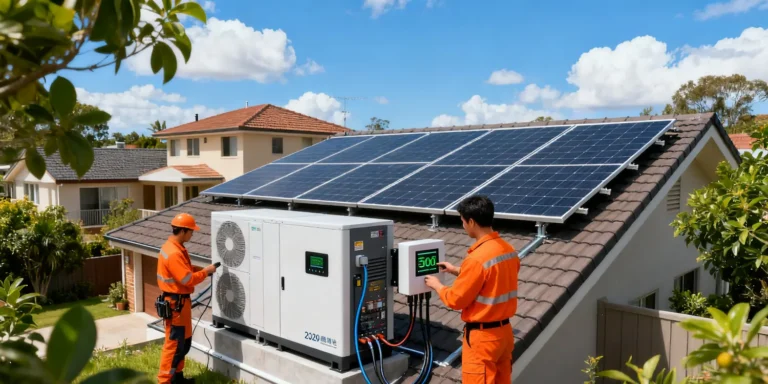
This is where sodium wins on a working farm or waste site. An LFP container in a northern winter needs a thermal management system drawing continuous parasitic power to stay above freezing, quietly eating the storage it was installed to provide. Sodium-ion retains most of its capacity at −20 °C without that heater, so the usable kilowatt-hours in January look much closer to the nameplate. On unoccupied sites with an outdoor container, that difference decides whether the mixers start on a cold morning.
Sizing for CHP and Grid Export
Start from the resilience requirement, then let the commercial case decide the rest. A typical mid-size plant might specify two to four hours of critical-load autonomy for ride-through, then add capacity until arbitrage and peak-shaving revenue clears the payback target — often four to eight hours on time-of-use export tariffs. Model it against a full year of half-hourly data including the winter months, because a summer-only model will overstate revenue badly.
Siting, Safety and Connection
Biogas sites carry a hazard most storage projects do not: methane. The container should sit outside the hazardous area classification, with cable routes and ventilation designed around the site’s ATEX zoning. Sodium-ion’s high thermal runaway threshold simplifies that conversation but does not remove it — the digester, gas holder and flare stack still dictate separation distances. Confirm the distribution network operator’s connection requirements early, since export limits and ramp rates often bind before the battery chemistry does.
Lifecycle Cost and Maintenance
Budget for a mid-life augmentation rather than assuming the original capacity lasts the full term. Sodium has shallower field data than mature LFP, so model replacement or augmentation of 10 to 20 % of modules around year eight. Remote monitoring is not optional: the bank should report state of health, cell balance and internal resistance to the plant SCADA so degradation is visible before it hits revenue.
What to Put in the Enquiry
Specify the usable energy at the coldest design temperature rather than at 25 °C, the round-trip efficiency including all parasitic loads, the exact autonomy at the critical load, the warranty terms written against cycles and calendar years, and the monitoring interface. Ask suppliers to quote both sodium and LFP against the same duty cycle — on a cold remote site the answer is rarely obvious until both are modelled.
People Also Ask
Why is sodium-ion attractive for biogas rather than just cheap? Because the duty cycle suits it: long standby near full charge, shallow daily cycling, cold unheated locations and an unconstrained footprint. Those are exactly where sodium’s weaknesses matter least.
Does a sodium battery need heating in winter? Far less than LFP. Sodium-ion retains over 90 % of capacity at −20 °C, so many installations run without a heater, avoiding the parasitic drain that shrinks usable lithium capacity.
How long does a sodium-ion bank last on a digester site? Expect 3000 to 6000 cycles, which at one shallow cycle per day is roughly ten years before capacity falls below 80 %.
Can the battery run the plant through a full grid outage? Yes if sized for it, but most plants specify ride-through for critical loads only — mixers, pumps and controls, not the whole site.
Modelling storage for a digester site? Request a quote with your load profile and minimum design temperature.
Written by Karl at China Battery Technology. Request a quote.
Related Reading
- sodium-ion battery technology guide
- Sodium-Ion Battery for Fertilizer Plant: Storage for a Corrosive Site
- Sodium-Ion Battery for Aquarium: Quiet Backup for Life Support