Custom Lithium Battery Pack Manufacturer: An OEM/ODM Guide for B2B Buyers
Custom Lithium Battery Pack Manufacturer: An OEM/ODM Guide for B2B Buyers
When procurement teams go looking for a lithium battery manufacturer to build a bespoke pack, the gap between a smooth program and a field-failure nightmare is almost always specification discipline. A custom lithium battery pack is not a catalogue part; it is a small power system built from cells, a battery management system (BMS), a mechanical enclosure, connectors and firmware. This guide walks B2B buyers—distributors, OEMs and integrators—through the decisions that actually move lead time, cost and reliability, and it gives you a reusable RFQ template at the end.

OEM vs ODM: what the labels mean for your pack
In battery sourcing, “OEM” usually means you own the electrical and mechanical design and the factory builds to print, while “ODM” means the factory owns reference designs you can private-label. For a custom lithium battery pack, a true ODM partner adds value by owning cell grading, BMS tuning and enclosure tooling. Clarify the scope you are buying early, because it decides who carries the certification burden and who must re-qualify when a cell model changes. A distributor wanting a quick private-label line should lean ODM; an OEM with a patented device should insist on OEM-to-print to protect IP.
Why the sourcing geography still matters
China remains the densest lithium-cell ecosystem on earth: cell fabs, BMS chipmakers, connector suppliers and pack assemblers sit within a day’s logistics of each other. That density is why a lithium battery manufacturer in the Pearl River Delta can turn a prototype in days while a fragmented supply chain elsewhere takes weeks. The trade-off is diligence: you must verify the factory is a real assembler with in-house engineering, not a trading company reselling someone else’s pack. Ask for the building address and a live video walk, not just a sales deck.
The specification sheet you must prepare first
Before asking for a quote, lock these parameters down. Ambiguity here is the number-one cause of sampling loops:
- Nominal and cut-off voltage (e.g., 25.6 V LFP, 54.6 V NMC).
- Capacity in Ah and the target watt-hours.
- Continuous and peak discharge current—peak matters more than average for motors and inverters.
- Dimensions and weight ceiling, including connector type and orientation.
- Communication protocol: CAN bus, RS485, SMBus or plain UART.
- Enclosure and ingress protection: IP54 for indoor, IP65/IP67 for outdoor and wash-down.
- Required certifications for your target market.
A concrete one-line spec such as “48 V, 100 Ah, 100 A continuous / 200 A peak, CAN J1939, IP65, IEC 62619 + UN38.3” removes 90% of ambiguity and lets engineering quote the same pack you imagine. Attach a sketch of the mechanical envelope; a picture of the cavity saves three rounds of dimensional negotiation.
Cell format: cylindrical, prismatic or pouch
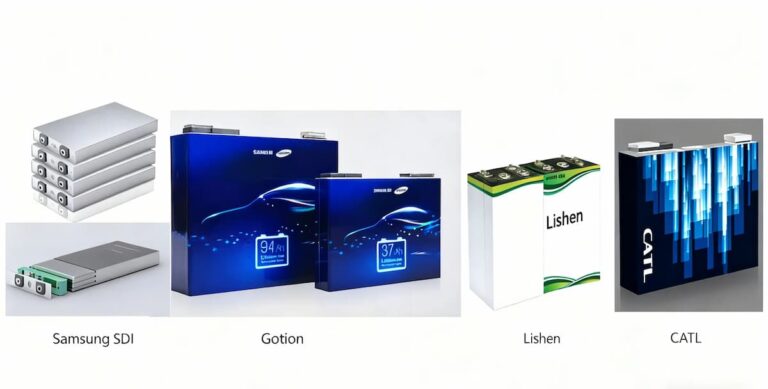
Cylindrical 18650 and 21700 cells offer mature supply and easy thermal escape; they suit high-C discharge tools and drones. Prismatic LiFePO4 cells deliver high capacity per volume and simple series strings, dominating stationary and motive power. Pouch cells win on form factor but need rigid bracing and careful swelling management. For most industrial packs, prismatic LFP or cylindrical NMC dominate. Insist on Grade-A cells with traceable batch codes—Grade-B or recycled cells are the silent killer of cycle life and the usual source of warranty claims. A good factory will show you the cell incoming-inspection records, not just a certificate of conformity.
Cell grading: the detail most buyers skip
Even Grade-A cells vary in internal resistance and capacity. A serious assembler sorts cells into tight bands (e.g., ±2% capacity, ±3 mΩ) before welding, then builds balanced modules. Ask to see the sorting report; if the factory cannot produce one, assume no sorting happened. Imbalanced modules age unevenly, and the weakest cell caps the whole pack’s usable capacity. Grading is cheap insurance against premature failure in the field.
The BMS is the brain, not an option
A battery application solutions program lives or dies on the BMS. At minimum it must provide over-voltage, under-voltage, over-current, short-circuit and over-temperature protection, plus cell balancing. Topology matters: a centralized BMS is cheap and fine for small packs, while a distributed (slave-per-module) design scales to large banks. For fleet and medical use, add SOH reporting and CAN telemetry so the host device reads state-of-charge remotely. Specify the communication bus explicitly—CAN J1939 for vehicles, RS485/Modbus for stationary, SMBus for portable computing gear. A BMS that speaks the wrong bus is useless no matter how good its protection.
Enclosure, thermal and IP
Enclosure material sets cost and safety: flame-retardant ABS for light duty, powder-coated steel for industrial, and die-cast aluminium where you need heat sinking. Pair the material with the right IP rating—IP54 keeps dust and splashes out; IP67 survives temporary immersion. Remember that lithium cells prefer 15–35 °C; an enclosure in a hot engine bay needs passive vents or active cooling, or you quietly halve the pack’s life. Design the thermal path before the cosmetic shell.
Certification matrix for B2B packs
| Standard | Scope | When you need it |
|---|---|---|
| UN38.3 | Transport safety testing | Always—required to ship by air/sea/road |
| IEC 62133 | Portable & medical cells/packs | Consumer, handheld, medical devices |
| IEC 62619 | Stationary industrial batteries | ESS, telecom, UPS |
| UL 1642 / UL 1973 | Cell / stationary system (North America) | US & Canadian market access |
| CE / RoHS | EU declaration & substance limits | European Union sales |
Regional nuance: North America leans on UL, the EU on CE plus EN standards, and many tenders now ask for semi-solid-state battery and sodium programmes to show roadmaps, though LFP remains the volume workhorse today. Build the cert list from your destination market, not from the factory’s default.
From sample to mass production
A typical timeline: engineering review (2–3 days), prototype (5–7 days), validation and tooling (1–2 weeks), then mass production in 15–25 days depending on cell inventory. Minimum order quantity for custom packs commonly starts around 100–200 units; lower MOQs are possible for modular reference designs. Build the schedule around your worst-case component lead time, not the factory’s optimistic quote. Pre-agree a pilot run of 20–50 units before committing the full PO; a pilot surfaces integration bugs at 1% of the risk.
How to vet the factory
Ask for three things before committing: an in-house BMS team (not a resold module), MES traceability so every pack maps to cell batches, and full test reports per batch. A credible lithium battery manufacturer will welcome a video factory tour and show you the aging and test benches, not just a sales deck. Red flags: no cell-sorting data, refusal to share test reports, and prices far below market for the stated grade. Also check whether they own the tooling for your enclosure or will subcontract it—subcontracted tooling adds a single point of failure.
Common specification mistakes
- Quoting continuous current but forgetting the 2-second peak that trips the BMS.
- Specifying IP67 when IP54 would do, doubling enclosure cost for no field benefit.
- Leaving the communication bus implicit and discovering the host can’t read SoC.
- Designing the pack to the absolute dimensional limit, leaving no service clearance.
Cost drivers you can actually control
Cell grade, BMS complexity, IP rating and certification scope drive 80% of pack cost. Standardizing on one cell format across your product line, and reusing a proven BMS, compounds savings far more than haggling per unit. The cheapest quote that quietly drops to Grade-B cells is the most expensive pack you will ever buy. Negotiate on volume and design reuse, not on cell grade.
Warranty, IP and NDA
Define warranty in cycles at a stated depth-of-discharge, not just months—”24 months” hides a 300-cycle pack behind a calendar that outlasts the cells. A short IP clause costs nothing and prevents painful disputes a year later. Confirm the factory will not sell your private-label pack to your competitor in the next territory, and that the NDA is mutual so your requirements are not leaked to a rival program.
A reusable RFQ template
Send suppliers this block: “Application: ___; Voltage: ___; Capacity: ___ Ah; Continuous/peak current: ___/___ A; Max dimensions: ___; Connector: ___; Comms: ___; IP: ___; Target certs: ___; EAU: ___ units; Required sample date: ___.” Suppliers answering precisely are the ones worth a second call.
Frequently asked questions
Can I get a sample before bulk order? Yes—reputable factories ship samples in under a week; treat the sample as a full validation, not a token.
Who owns the certification if the factory designed the pack? Usually the factory holds the test report; your brand appears on the declaration. Confirm IP and NDA terms up front.
What kills cycle life fastest? Heat and chronic deep discharge. Specifying a conservative depth-of-discharge (80%) and adequate cooling beats chasing the cheapest cells.
How do I keep my design exclusive? A mutual NDA plus a contractual non-resale clause for your territory; verify the factory’s reference designs are not already sold to a direct competitor.
Written by Karl at China Battery Technology. Need a custom pack spec reviewed? Request a quote and our engineers will return a design within 24 hours.
Related Reading
- custom lithium battery manufacturer
- Lithium Battery for Forklift: Retrofit, Sizing and Total Cost of Ownership
- LiFePO4 Battery Manufacturer in China: How to Vet a Factory