Sodium-Ion Battery for Water Bottling Plant
Sodium-Ion Battery for Water Bottling Plant
Bottling is a business of short, sharp peaks. A line idles at a few kilowatts, then a rinse-fill-cap block starts and the whole plant steps up within a second, over and over through a shift. A sodium ion battery is a good fit for that pattern: it accepts high charge and discharge rates without complaint, tolerates the temperature range of an unheated warehouse, and costs less per kilowatt-hour than lithium when the buffer needs to be physically large.
The Shape of a Bottling Load
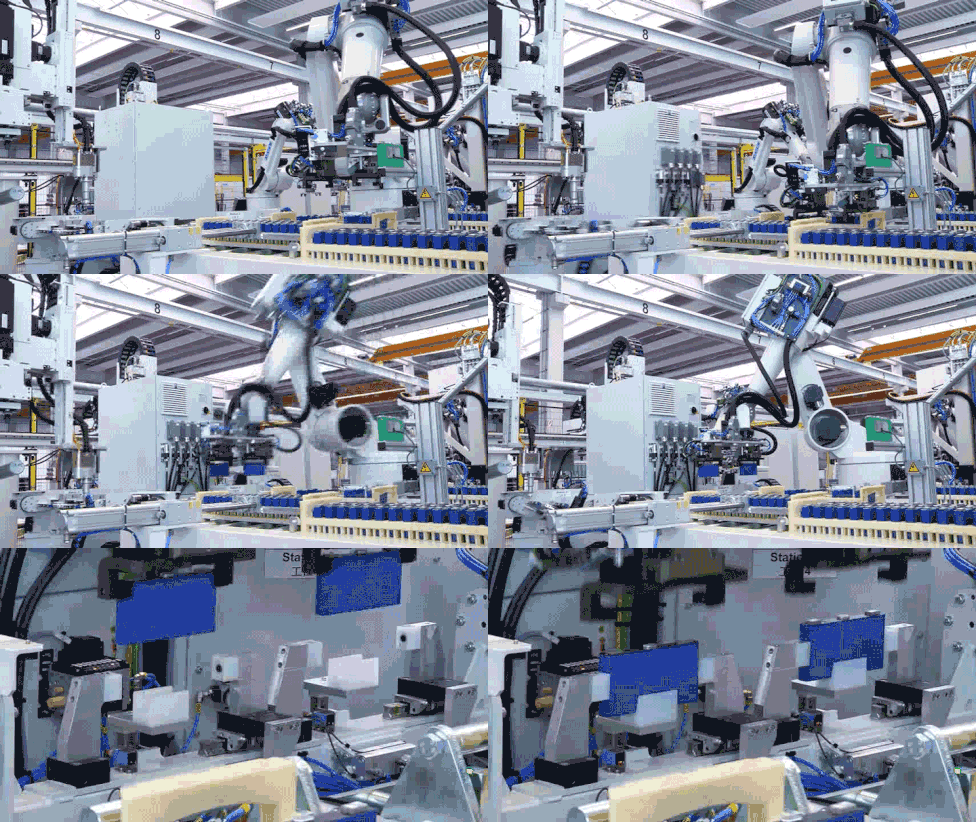
Three things dominate. Rinse and fill blocks cycle with the line, blow moulders draw a compressed-air load that spikes hard, and the cold-fill chillers run a steady base with defrost spikes. Air compressors are usually the worst offender: a unit that averages 30 kW can demand 150 kW for four seconds on a restart, and it restarts every time receiver pressure drops during a fast run.
Why Sodium Suits High-Cycling Duty
Sodium-ion cells handle aggressive partial cycling without the plating and degradation mechanisms that make fast, repeated charge pulses expensive in cold lithium packs. That matters on a bottling line, where the battery may take several hundred shallow cycles a day absorbing compressor starts rather than one deep cycle. Sodium also retains capacity well below freezing, so a plant that stores product at 4 °C does not need to heat its battery room.
Peak Shaving Without Slowing the Line
The usual goal is to keep the incoming supply below a contracted capacity while the line runs flat out. Storage sits in parallel, sees a step increase, and covers the difference for those few seconds until the compressor settles. Done properly the plant never throttles production to stay under a demand ceiling, which is the real prize: the line keeps its rate and the demand charge stays flat.
| Attribute | Sodium-ion | LFP lithium | Diesel only |
|---|---|---|---|
| High-rate partial cycling | Excellent | Good | Poor |
| Cold-room performance | Strong | Needs heating | Good |
| Cost per kWh | Lower | Medium | — |
| Energy density | Low–medium | Medium | — |
| Footprint | Larger | Compact | Large |
Sizing Against the Compressor, Not the Nameplate
Log the site at one-second resolution for a full production week before specifying anything. The number that sets the inverter size is the peak power over a rolling five-second window, not the sum of motor nameplates. Once surge is covered, size energy for the busiest fifteen minutes of the shift plus a modest reserve, because beyond that point extra capacity mostly sits unused.
Water, Humidity and Hygiene
Bottling halls are wet, cleaned with chemicals and kept cool. Specify IP65 enclosures with sealed glands, avoid locating the battery where it can be hit by a pressure washer, and keep the cabinet clear of floor drains. Where the room is cooled to single digits for product reasons, confirm the BMS low-temperature charge behaviour in writing rather than assuming it.
Keeping Production Records Clean
A line stop caused by a voltage dip costs more than the energy it took to cause it: partially filled bottles, a restart sequence and a quality check. Put the fill-level sensors, the coder and the line PLC on the backed-up bus so a disturbance never becomes a quality event. Export BMS and line data to the same historian so the maintenance team can correlate the two.
What to Ask a Supplier
Ask for the five-second surge curve at your operating temperature, the cycle-life warranty stated at your real depth of discharge, the ingress rating and gasket material, and whether the BMS integrates with your plant SCADA over a documented protocol. Be sceptical of a warranty quoted at 50% depth of discharge when your duty cycle never goes that deep.
People Also Ask
Can storage let me run a faster line on the same supply? Often yes. If the constraint is contracted capacity rather than the machine itself, a buffer sized to compressor surge will absorb the starts that would otherwise breach it.
Does sodium work in a chilled bottling hall? Yes. Sodium-ion retains most of its capacity below freezing, so a 4 °C hall needs no battery heating in normal operation.
How much energy does a typical line need? A single mid-speed line with blow moulding usually lands between 150 kWh and 400 kWh of buffer, depending on how much of the compressed-air load sits on the critical bus.
Will it replace the generator? Not usually. It reduces how often the generator runs and how large it needs to be, rather than removing it from a plant that must survive multi-day outages.
Written by Karl at China Battery Technology. Request a quote.