Semi Solid State Battery for Electric Boat: Marine Duty, Packaging and Range
Semi Solid State Battery for Electric Boat: Marine Duty, Packaging and Range
Electric boats punish batteries in ways cars do not. A hull is a wet, vibrating, salt-sprayed box that tilts, and the pack sits low where the bilge water goes. A semi solid state battery for electric boat duty answers a specific engineering problem: how do you put 40 to 120 kWh into a hull with a usable 80 % depth of discharge, keep the pack cool enough in a cabin that reaches 50 °C under a black hull in August, and still charge it on a pontoon where the shore supply is a 32 A single-phase socket on a fifty-metre cable? Semi-solid and solid-state cells with a polymer or composite electrolyte have the energy density to answer that, but the packaging discipline around them determines whether the boat actually gets the range on paper.
This article is written from the perspective of a pack engineer who has put these cells into hulls: what the chemistry gives you, what it takes away, how to lay out a marine pack, what the real-world derating looks like, and which certifications a marine integrator will be asked for.

Why the marine duty cycle differs from everything else
A torpedo-shaped survey vessel running a two-day hydrographic survey draws 6 to 9 kW at cruise and 22 kW at survey speed, and it needs a silent night watch of 300 W for twelve hours with the genset off. A canal boat with a 90 kW electric drive uses 4 kWh per hour at displacement speed and nearly all of its energy in the low-speed, high-current band around 800 to 1500 rpm, where internal losses rise fast. A racing electric outboard cares about 12-second bursts of 60 kW and then nothing for twenty minutes. Those three profiles need three different pack designs even if the same semi-solid cells are used, because the cell’s great strength — high energy density — is in the way when you need burst current, and the electrolyte’s stiffness is in the way when you need fast charge.
The other marine-specific factor is that a boat’s usable energy is not the pack’s nameplate energy. You cannot discharge a battery to zero on a boat; a fully discharged house bank at 3 am means the bilge pump is running on what is left and the chart plotter is about to drop out. A realistic marine rule is 80 % depth of discharge for a propulsion pack and 70 % for a house bank, and with a semi-solid pack you should add hysteresis for tilt: a battery, not a boat, that sits at 20 °C and swings 15 °C while the hull rolls will see its usable capacity drop by a few percent at the extremes.
What semi-solid actually means in a marine pack
The term covers a spectrum. A semi solid state cell typically retains a small liquid or gel fraction — often 5 to 20 % by weight — alongside a composite cathode and a solid or quasi-solid electrolyte layer, which gives it better rate capability than a fully ceramic cell while removing most of the freely-flowing electrolyte that makes a liquid cell vulnerable in a puncture scenario. Fully solid-state cells push that fraction to near zero and gain the most in safety and energy density, but they still struggle with interfacial resistance and fast charging, which is why the fully solid versions are appearing in low-rate, high-energy applications rather than in outboards.
| Cell type | Energy density | Continuous discharge | Cold behaviour | Marine suitability |
|---|---|---|---|---|
| LiFePO4 prismatic (marine) | 130–160 Wh/kg | 1C, burst 3C for 5 s | 70 % at −10 °C, no cold charge | Proven, cheap, heavy, well-understood BMS |
| NMC / NCA pouch (marine) | 200–250 Wh/kg | 3C, burst 6C | 75 % at −10 °C, needs heating | High range, thermal risk in a bilge fire |
| Semi solid state (composite) | 230–330 Wh/kg | 2–3C, burst 5C | 80 % at −20 °C, partial cold charge | Best range-per-kilo with real safety margin |
| Fully solid state (sulfide/ceramic) | 350–450 Wh/kg (lab to pilot) | 1C, limited burst | Good, brittle interface | Pilot fleets only; charge rate is the limit |
| Sodium-ion (marine) | 115–140 Wh/kg | 2C, excellent charge | 92 % at −20 °C, charges cold | Cheap, cold-tolerant but low range |
Packaging: IP66, IP67 and the vibration problem
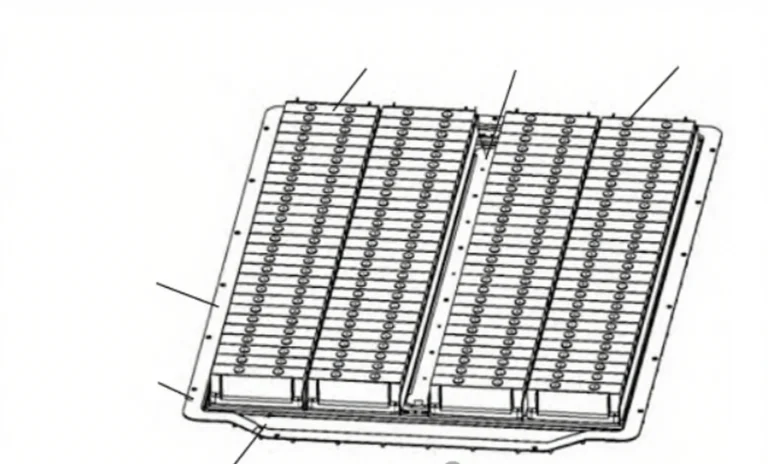
Semi-solid cells arrive typically in pouch or prismatic form. Pouch cells are light and conform to a hull’s odd shape, but they swell and need a rigid case with a constrained stack; a boat is exactly the place where you must never rely on a soft pack surviving a 3 g slam from a 3 m wake plus an engine mount resonance at 90 Hz. In practice we put pouch semi-solid stacks into a fibre-reinforced polymer case with a potted thermal path to an aluminium cold plate bonded to one hull skin, and we rate the whole enclosure IP67 with a secondary IP66 shroud on the vent path, because the difference between a cabin hatch that drips and one that lets a wave in is one wave.
Vibration matters for the cell interfaces more than for the case. Semi-solid electrolytes are mechanically stiffer than liquid, which is good for puncture resistance but means the electrode stack takes cyclic strain differently; a pack that is clamped with compliant end blocks and a pre-load in the range of 0.3 to 0.6 MPa will outlive one that is simply bolted. The BMS also has to sample faster than a stationary pack: at 100 Hz per cell group rather than 1 Hz, because a short-circuit on a boat happens in the same few milliseconds as anywhere else and the contactor has to open before the electrolyte warms.
Thermal management in a hot cabin
Marine packs are usually room-temperature-rated by the cell maker and then installed in the worst possible place. In a 12 m motor yacht’s engine room in the Mediterranean, ambient can sit at 50 °C; in a steel trawler’s forepeak the same pack may see 4 °C and heavy condensation. Semi-solid chemistry tolerates both better than NMC, but the charge window is still the binding constraint: most semi-solid cells accept charge over 0 °C to 45 °C and must be prevented from charging outside it, so the boat’s charger has to be BMS-gated, not simply a fixed-voltage shore unit. Discharge can go to 60 °C cell temperature, which on a summer passage means continuous 1.5C discharge is fine but 3C burst should be limited to a few seconds.
Realistic derating and a worked range example
An 80 % depth-of-discharge marine pack will, in practice, deliver less than its nameplate in the first year if it is sized without derating. Our rule for a semi-solid marine pack is to derate by 8 % for continuous high-rate discharge, 5 % for cabin ambient above 35 °C, 4 % for altitude and hull tilt deviation, 3 % per 1000 charge cycles at 80 % of the original cycle budget, and a further 3 % for cold-start. Working example: a 60 kW semi-solid pack of 100 kWh nameplate, used in a 40 ft trawler at an average 18 kWh/h cruise with a 30 % reserve, needs 60 kWh usable. Nameplate 100 kWh less 20 % depth-of-discharge reserve leaves 80 kWh, then apply the 8 % rate derating to get 73.6, the 5 % thermal derating to 69.9, and the 3 % tilt derating to 67.8 kWh — comfortably above the 60 kW-hour requirement with a margin of a little over 12 %. Had the pack been specified at nameplate only, the margin would have looked larger than it really is, and the vessel would have been anchoring for a partial charge after four hours instead of five and a half.
Certification and the shore-power question
Marine lithium and semi-solid packs move under UN38.3 and are installed under the relevant flag state rules; in Europe that means the pack and its installation should be assessed against IEC 62619 for the battery and IEC 62477 for the power conversion equipment, with many classification societies — Lloyd’s Register, DNV, ABS — publishing their own guidance on lithium installations that goes beyond the product standard. Two public sources are worth citing when a design review questions the choice. The International Energy Agency tracks where marine and road electrification sits in its energy outlooks and is a useful anchor for why hull owners are converting at all, and the National Renewable Energy Laboratory publishes the fast-charge and thermal-degradation work that underpins the derating figures most marine packs now ship with. If the boat is a commercial vessel carrying passengers, expect the surveyor to ask for a thermal propagation analysis, a fixed gas or VoIP fire detection in the battery compartment, and a documented emergency shutdown that is reachable from the helm and from outside the cabin. Boat builders also have to think about the shore-power interface: a semi-solid pack that can accept 1C at 25 °C will charge in about an hour from a 32 A single-phase supply if the charger is correctly gated, but only if the boat’s shore inlet and cable are rated for the sustained current rather than the peak.
Where semi-solid is the right call on a boat
Long-range passagemaking with a constrained battery volume — a 30 to 45 kWh house bank where every kilogram of pack costs you a berth or a water tank — is the clearest fit, because the 230 to 330 Wh/kg cell density buys you range that a LiFePO4 bank simply cannot fit in the same hull. Electric ferries and workboats with a fixed daily route and a shore charge every night are a good second fit, particularly where the operator values the reduced fire risk in a confined engine room. It is a poor fit for a small inflatable with an outboard where the pack must survive a 4 kg drop onto a rock, and for a racing outboard where 60 kW of ten-second burst is everything and the extra 40 g per kWh of semi-solid cell isn’t worth the rate loss.
People Also Ask
How much longer will a semi solid state battery last compared with LiFePO4 on a boat? Cycle life depends more on depth of discharge and temperature than on chemistry. Semi-solid cells often quote 3000 to 6000 cycles at 80 % DoD versus 6000 to 8000 for marine LiFePO4, but because a boat rarely discharges below 20 %, the practical difference over a ten-year hull life is often small, and the energy-density gain usually pays for itself in range.
Can I charge a semi-solid marine pack from a normal shore power socket? Yes, provided the charger is BMS-gated and the shore cable and inlet are rated for the sustained charging current. Semi-solid cells tolerate charge rates of 1C to 2C in the mid state-of-charge window, so a 32 A single-phase supply can usually refill a 40 kWh bank in roughly two to two and a half hours, with charge taper near the top.
Is a semi solid state battery safe in a bilge with salt water? The cells themselves are far less prone to thermal runaway than liquid-electrolyte lithium cells, and several semi-solid chemistries use non-flammable electrolytes. What still matters is the enclosure: an IP67 case with a non-return vent, corrosion-grade cabling, cell-level fusing and a thermal propagation barrier, because salt water plus a cracked case is an electrical problem regardless of how stable the chemistry is.
Which certification should I ask a marine pack supplier for? UN38.3 for transport, IEC 62619 for the battery’s safety performance, and IEC 62477 for the charger and bidirectional inverter. If the vessel is surveyed commercially ask your classification society directly for its lithium installation guidance, and get the thermal propagation analysis and emergency shutdown documentation before you buy rather than during the survey.
Written by Karl at China Battery Technology. Request a quote.