Lithium Battery for Railway and Transit: Signaling Power
Lithium Battery for Railway and Transit: Signaling Power
Railway signaling is safety-critical in the deepest sense: a dark signal can cause a collision. Trackside cabinets, level-crossing controls, and interlocking systems must stay powered through grid failures, because the train does not stop for a blown fuse. The battery in that cabinet is not a convenience backup — it is a fail-safe mandated by regulation, and its reliability is designed to a standard no consumer product approaches. Specifying it correctly demands a lithium battery manufacturer who builds to rail compliance, not a generic pack vendor, because the cost of a signaling blackout is measured in lives, not downtime.
Signaling is safety-critical, not convenience
Unlike an office UPS that buys time to save a file, a signaling battery must hold the system in a safe state through an extended outage — ideally failing to a red, stop, or diverging indication rather than a clear one. The design philosophy is fail-safe: any battery fault must drive the signal to the most restrictive aspect, never to a false clear. That single principle shapes every choice: cell quality, BMS redundancy, monitoring, and the maintenance regime. A procurement manager who treats this like a cheaper UPS specification has misunderstood the stakes entirely.
Why lithium replaces VRLA in trackside cabinets
For decades the standard was valve-regulated lead-acid (VRLA), sized for an eight-hour bridge to a backup generator. VRLA is cheap but temperamental: it sulphates, it self-discharges in heat, and its real life in a trackside cabinet is often two to four years. Lithium (LFP) delivers 2,000–6,000 cycles, 90% usable, near-zero self-discharge, and a far wider temperature band. For a battery application solutions program covering hundreds of cabinets, the maintenance saving alone is decisive — every VRLA swap is a track possession, a protected work window, and a crew near live rails, which is the most expensive labor in the industry.
Sizing for fail-safe backup
Sizing follows the signaling load and the required bridge time. A level-crossing controller might draw 50–150 W continuously with a gate-motor surge; an interlocking cabinet might draw 200–500 W. Bridge time is set by regulation and the backup-generation plan — commonly two to eight hours, sometimes longer for remote single-track lines. The table shows typical needs:
| System | Load | 4-hr bank | 8-hr bank |
|---|---|---|---|
| Level crossing | 100 W | 0.5 kWh | 1.0 kWh |
| Signal cabin | 300 W | 1.5 kWh | 3.0 kWh |
| Interlocking | 500 W | 2.5 kWh | 5.0 kWh |
The surge from a gate motor or point machine must be added on top; the inverter and BMS must clear it without tripping, because a protection trip during a bridge is itself a signaling failure. Size for the surge, then the bridge, then a margin for the hot day when the cells are weakest.
The float-charge and depot-charge profile
Trackside batteries sit mostly on float charge from the lineside supply, exercising only during an outage. The charge profile must hold LFP at the correct upper voltage without over-charge, and the BMS must enforce its own cutoff as a backstop. Many rail sites also support depot or solar top-up. Critically, the system must routinely exercise the battery — a periodic discharge test — because a bank that is floated for three years and never tested may have quietly failed. The BMS telemetry should log these tests so compliance is demonstrable, not assumed.
BMS and redundancy for life-safety
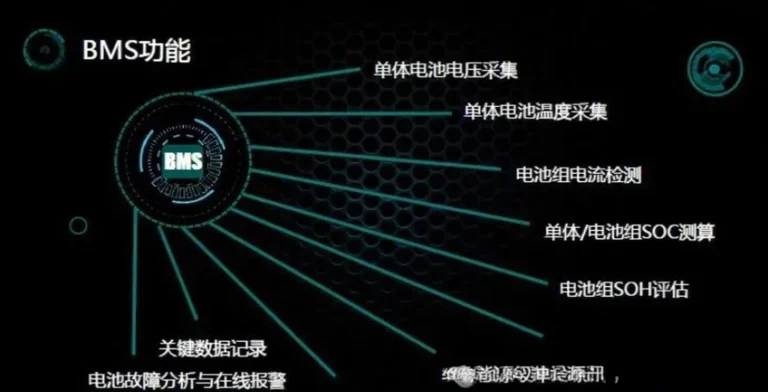
For signaling, the BMS is a safety device with redundancy. Protection paths should be independent of the telemetry path, so a communications failure cannot disable protection. The system should report per-cell voltage, temperature, and state-of-health to the control center, and raise an alarm on any deviation long before capacity is exhausted. A home energy storage system failing is an inconvenience; a signaling BMS failing silently is a regulatory breach. Specify redundant protection and alarm-on-degrade, and require the supplier to document the failure modes and their safe-state responses.
Temperature extremes trackside
A trackside cabinet sees everything: desert heat that bakes the battery, alpine cold that threatens charge plating, and the vibration of passing trains. The enclosure must buffer temperature, resist ingress, and isolate the cells from mechanical shock. A low-temperature charge cutoff is mandatory in cold climates, and the cabinet should avoid sitting the battery above the rail where heat radiates. The cells must meet their rated life at the cabinet’s actual temperature band, not a laboratory 25 °C, and the supplier should warrant against the site’s recorded extremes, not a generic range.
Cycle life and the 10-year mandate
Rail assets are planned on decades, and the battery is expected to serve a long interval between possessions — commonly a 10-year design life target. LFP’s 2,000–6,000 cycles and low self-discharge make that achievable where VRLA would need three or four replacements, each a track possession. The life extension is the business case: specify cycle life at the real depth-of-discharge (often shallow float with rare deep discharge, which extends life) and put a cycle-based, condition-based warranty in the order so the supplier stands behind the number in your climate and vibration environment, not a bench.
Chemistry options: sodium and semi-solid
For weight-irrelevant trackside cabinets, a sodium-ion battery is worth evaluating on cost and cold tolerance, though its field record in safety-critical rail is not yet established and certification will be the gate. A semi-solid-state battery is the wrong fit — its density premium buys nothing in a spacious cabinet, and its newer supply chain adds qualification risk to a life-safety application where proven behavior is non-negotiable. Keep LFP as the default for rail until any alternative clears the same compliance and field-record bar.
A specification checklist
| Item | Requirement |
|---|---|
| Fail-safe | Fault drives most-restrictive aspect |
| Bridge time | Per regulation, + surge margin |
| BMS | Redundant protect + alarm-on-degrade |
| Charge | LFP float profile, cold cutoff |
| Enclosure | Vibration-isolated, temp-buffered, IP |
| Life | 10-yr target, cycle warranty |
Score every bid against this and only vendors who build to rail discipline survive. The one that passes all six keeps the signal safe through the outage that justifies its existence; the cheap pack that fails the redundancy or certification row is a liability no savings can justify.
Condition-based monitoring and predictive replacement
Rail operators are moving from calendar-based battery swaps to condition-based replacement driven by BMS telemetry. By tracking per-cell voltage, internal resistance and delivered capacity across periodic exercise tests, you replace a cabinet when its data shows degradation, not on a fixed date that may be early or late. This avoids both premature disposal and dangerous late failure. The telemetry must be audit-grade: time-stamped, tamper-evident, and retrievable for compliance review, because a signaling battery’s record is a safety document, not a maintenance note, and an inspector will read it as such.
Acceptance testing and documentation
Every signaling battery must be acceptance-tested: capacity at the site temperature band, verification of the fail-safe response (a forced fault must drive the most restrictive aspect), and a logged full discharge to confirm bridge time including the gate or point-machine surge. The results become part of the safety file. A cabinet that cannot demonstrate its bridge time and its safe failure mode has no place on a live railway, regardless of how good the cells look on paper, because the paper is what lets the authority approve the signal in the first place.
Decommissioning and second-life
At end of rated life an LFP rail bank still holds 70–80% capacity, but safety-critical rules usually retire it from signaling regardless. That capacity is not waste — it can serve non-safety trackside loads or be recycled through a documented chain. Because rail batteries are high-value and regulated, plan decommissioning at purchase: a bank with a complete, auditable history is easier to reuse or recycle compliantly than one whose record is missing. The lifecycle discipline that protects the railway also reduces its environmental and cost footprint, which is a rare case where safety and sustainability pull in the same direction.
Frequently asked questions
How long must a signaling battery bridge? Set by regulation and backup plan — commonly two to eight hours, longer on remote single-track lines; size for the surge too.
Why replace VRLA with lithium? Lithium lasts far longer in a trackside cabinet, cutting dangerous and costly track possessions for battery swaps.
Is sodium viable for rail? Cost-attractive in spacious cabinets, but its safety-critical field record and certification must be proven first; LFP remains default.
How is compliance demonstrated? BMS telemetry logs periodic discharge tests and per-cell health, giving auditors evidence the bank is fit, not assumed.
Written by Karl at China Battery Technology. Tell us your signaling load, required bridge time and site climate and we will spec the bank — request a quote for a fail-safe pack.
Related Reading
- custom lithium battery manufacturer
- Lithium Battery for Agricultural Drone: Spray and Spread
- Lithium Battery for Material Handling: Beyond the Forklift