Lithium Battery for Warehouse Robotics: 24/7 Duty Cycles
Lithium Battery for Warehouse Robotics: 24/7 Duty Cycles
Warehouse robots do not get weekends. A goods-to-person AMR, a tow tug or a pallet shuttle running three shifts a day will demand a full charge and discharge every few hours, 365 days a year, and the battery is the only component in the system that feels every one of those cycles. Specifying a pack for this duty is not the same as sizing a phone or a forklift; it is a continuous-cycling problem where the wrong chemistry, charge profile or thermal path quietly destroys throughput. This guide is written for the engineer or procurement lead who has to put a number on a battery that never rests. When you brief a lithium battery manufacturer, the duty cycle, not the headline Ah, is the conversation that matters.
What 24/7 duty actually demands
A robot that runs 20 to 22 hours a day typically cycles its pack between two and four times per shift, depending on the opportunity-charging window. Over a year that is 2,000 to 3,500 equivalent full cycles, which is already at the edge of what a modest lithium pack survives. The failure mode is not a sudden death; it is a slow capacity fade that first shows up as “the robot needs a charge mid-task,” then as missed pick windows, then as a dead robot blocking an aisle. Because the fleet is interdependent, one weak pack degrades the whole line’s throughput, so the pack must be specified with margin and monitored cell-by-cell. Treat the duty cycle as a continuous stress test, because that is what three-shift operation is.
Chemistry choice: LFP is the default for a reason
For warehouse robotics, lithium iron phosphate (LFP) is the workhorse because it tolerates deep, frequent cycling better than NMC and stays thermally calm under a roof full of people and inventory. NMC packs more energy per kilogram, which matters for a flying drone but rarely for a floor-bound AMR where weight is paid for by the wheels, not by lift. A sodium-ion battery is appearing for stationary buffer uses but is not yet a fit for high-rate robotic cycling. The table below frames the real trade for a robot that cycles four times a day.
| Chemistry | Typical cycles at 80% DoD | Energy density | Thermal risk | Fit for 24/7 robotics |
|---|---|---|---|---|
| LFP | 3,000-6,000 | 90-160 Wh/kg | Low | Best default |
| NMC | 1,000-2,000 | 150-250 Wh/kg | Moderate | Only if weight is critical |
| Sodium-ion | Emerging | 100-160 Wh/kg | Very low | Not yet for high-rate cycling |
The numbers say it plainly: at four cycles a day you will reach 3,500 cycles in roughly 2.5 years on LFP, while NMC would be past its rated life in under two years and asking for more frequent pack swaps. For a fleet of hundreds, that difference is the difference between a scheduled swap and a wave of unplanned failures.
Opportunity charging versus battery swap
Two models exist. Opportunity charging tops the pack during short idle windows at pick stations or along a charge strip, keeping the robot in service with one pack. Battery swap gives each robot a fresh pack at a docking station and sends the drained one to a slow charger. Opportunity charging suits LFP because it tolerates partial-state charging without memory; swap suits sites that cannot afford a robot to sit still even for a fast charge. Either way, the charge profile must be matched to the cell, and a fast charger that pushes current the BMS cannot govern will cook a pack faster than any usage pattern. Define the model before you size, because it changes the peak C-rate the pack must survive.
Thermal management in a working warehouse
Warehouses are rarely climate-controlled to battery-friendly temperatures. A pack that charges at 1C in a 35 °C summer aisle will age faster than the datasheet implies, and a pack that cold-soaks overnight in a winter depot and then fast-charges risks lithium plating. The enclosure needs a documented thermal path and, for hot sites, some airflow or conduction to the chassis. A home energy storage system sits in a vented utility room; a robot sits in the busiest, dustiest, hottest part of the building, so its thermal budget is tighter, not looser. Ask the supplier for the pack’s allowed charge-temperature window and design the charging bay to stay inside it.
BMS requirements for a never-resting pack
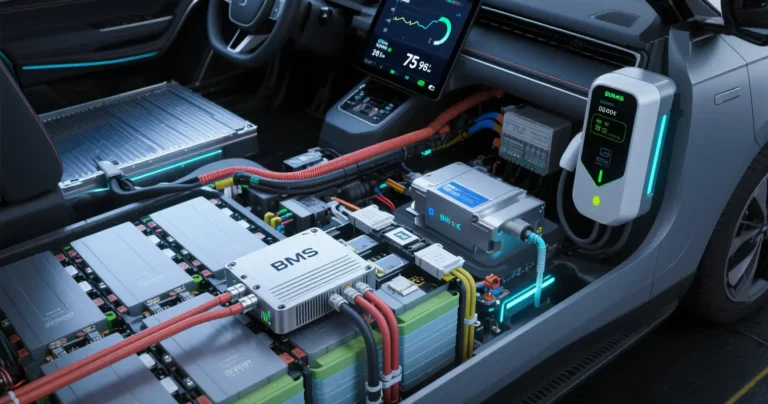
The BMS on a 24/7 robot is doing real work. It must enforce per-cell voltage limits through fast charge and hard acceleration, log every cycle so you can predict end-of-life, and report state-of-health over the robot’s CAN bus so the fleet manager pulls a pack before it strands a robot. A battery application solutions program that skips SOH telemetry turns every weak cell into an unplanned outage. Specify active balancing for multi-cell robot packs, because passive balancing lets one weak cell cap the whole string’s usable capacity and silently shortens run time. The BMS is where the duty cycle is actually managed.
Cycle life under continuous cycling
Cycle life is conditional, and 24/7 duty is the condition that breaks lazy specifications. A pack rated 3,000 cycles at 80% DoD will deliver fewer if you routinely pull 100% DoD or fast-charge in heat. The practical move is to cap Depth-of-Discharge at 80% in firmware so the robot never fully empties, and to log delivered throughput so you can see the fade curve. A semi-solid-state battery could extend run time per kilogram in a weight-sensitive robot, but for a floor robot the life-versus-density math usually favors LFP. Whatever you choose, put the cycle rating and its test condition in the purchase order so the number is enforceable, not a brochure promise.
Sizing a fleet battery: a worked example
Take an AMR that draws 15 A average and peaks at 60 A for 2 seconds during acceleration, with a 4-hour run between charges. A 60 Ah LFP pack gives 4 hours at 15 A (0.25C continuous) with margin for the peak, and at 80% usable DoD that is 48 Ah delivered. Over a 20-hour day with opportunity charging, the pack cycles roughly 4 times, so 3,000 rated cycles buys about two years of service before planned swap. Size the busbar and connector for the 60 A peak, not the 15 A average, because the peak is what heats the interface and trips a careless BMS. Hand the supplier your continuous and peak amps and your required run time, and reject any pack quoted only on headline Ah.
Failure modes specific to robotics
Robotic packs fail in ways a stationary bank does not. Vibration loosens a lug, and a loose lug at the peak C-rate is a heater. A dock that misaligns and scratches the pack housing exposes cells to moisture in a washed-down aisle. A BMS that loses its CAN connection leaves the robot blind to state-of-charge and the fleet manager blind to health. The discipline is mechanical as much as electrical: torque the connectors to spec, protect the housing, and verify the communication bus in the integration test, not after the first stranded robot. Most “battery failures” in robotics are actually interface or integration failures wearing a battery costume.
Procurement checklist
- State the duty cycle in cycles per day and the target service life in years.
- Name the chemistry and the rated cycles at 80% DoD with temperature and C-rate.
- Confirm the charge profile matches the cell and the BMS governs it.
- Require SOH telemetry over the robot’s bus (CAN/RS485).
- Size busbar and connector for the peak, not the average, current.
- Put the cycle-based warranty in the purchase order.
- Log throughput in the field so you can schedule swaps before failure.
Total cost of ownership for a robot fleet
The cheap pack is the expensive pack here. A $400 pack rated 2,000 cycles that fails in 18 months costs more across a 300-robot fleet than a $600 pack rated 4,000 cycles, because the swap labor, the downtime and the blocked aisle dominate the math. Divide pack price by expected cycles at your real DoD and compare $/cycle across suppliers; the ranking usually inverts. A disciplined buyer also reserves packs for second-life use as stationary buffers once they drop to 70-80% capacity, recovering some value. The battery decision for a 24/7 fleet is a TCO decision wearing a spec-sheet costume, and the spec sheet is where most buyers lose money.
Frequently asked questions
Which chemistry is best for warehouse robots? LFP, because it survives deep frequent cycling and stays thermally calm; NMC only if payload weight is the binding constraint.
How many cycles should I spec? At 3-4 cycles per day you need 3,000-plus rated cycles at 80% DoD to get two years before planned swap.
Opportunity charge or swap? Opportunity charging suits LFP and keeps one pack per robot; swap suits sites that cannot afford any idle time.
Why does the BMS matter so much? It enforces limits through fast charge and hard accel, logs cycles, and reports health so you pull a pack before it strands a robot.
Written by Karl at China Battery Technology. Tell us your cycles per day, run time and peak current and we will size the pack—request a quote for a 24/7-rated robot battery.
Related Reading
- custom lithium battery manufacturer
- Lithium Battery for Emergency Lighting: Code and Runtime
- Lithium Battery for Start-Stop Vehicles: Cranking and Cycling