Battery Solutions for Disaster Relief Shelter Power
Battery Solutions for Disaster Relief Shelter Power
When a school gymnasium becomes a shelter for four hundred people, the power problem arrives before the cots do. Lighting, phone charging, medical refrigeration, CPAP machines overnight and a kitchen line all need electricity in a building whose grid connection is probably the reason the shelter exists. Diesel generators have carried this role for decades, but they are loud enough to prevent sleep, produce exhaust that must be routed away from doorways, and depend on a fuel convoy that may not arrive. Modern battery application solutions replace much of that load with equipment that is silent, emission-free indoors, and ready to work the moment it is unloaded.
What a Shelter Actually Consumes
Relief planners routinely overestimate total demand and underestimate peak demand. A 400-person shelter typically runs 3 to 6 kW continuously for lighting, communications, fans and phone charging, spiking to 15 or 20 kW when the kitchen, water heaters and medical equipment coincide. Over 24 hours that is roughly 80 to 130 kWh. Two facts follow. First, a modest battery covers a whole night without any generator running, which is the single biggest quality-of-life improvement a shelter can offer. Second, sizing to the peak alone produces an oversized, unaffordable system, so the right architecture pairs storage with a generator that runs a few hours daily rather than continuously.
Three Deployment Tiers
Field experience sorts shelter power into three practical tiers. Portable stations of 1 to 3 kWh handle communications and device charging and can be carried by one person. Rack or cart systems of 10 to 30 kWh with an integrated inverter run lighting circuits, medical refrigeration and CPAP loads for a full night. Trailer or container systems of 50 to 200 kWh support a whole facility including kitchen equipment and can accept solar or generator input. Most agencies find the middle tier does the heaviest lifting because it fits through a standard doorway and needs no crane.
Comparing Shelter Power Options
| Attribute | Battery System | Diesel Generator | Battery + Generator Hybrid |
|---|---|---|---|
| Indoor operation | Safe | Prohibited | Battery indoors, genset outside |
| Noise at 7 m | Under 45 dB | 70–85 dB | Quiet except during recharge |
| Setup time | Minutes | 30–60 min plus fuel | Under an hour |
| Fuel logistics | None | Daily resupply | Roughly 70% less fuel |
| Runs overnight silently | Yes | No | Yes |
| Endurance without resupply | 1–2 days | Fuel dependent | Weeks |
The Hybrid Pattern That Works
The most effective shelter deployments do not choose between battery and generator; they sequence them. The generator runs for three or four hours in the late afternoon at high load factor, recharging the battery while the kitchen operates, then shuts down before dusk. The battery carries the shelter silently through the night and the morning. Fuel consumption drops by around 70 percent because the engine never idles at 20 percent load, engine hours fall by a similar margin, and residents sleep. Deployments that follow this pattern consistently report the noise reduction as the change occupants notice most.
Chemistry and Transport Realities
LiFePO4 dominates this category and deserves to. It tolerates heat, resists thermal runaway, survives being handled by volunteers rather than technicians, and delivers thousands of cycles so the same units serve many activations. Sodium-ion is becoming credible for cold-region caches because it holds capacity in freezing storage. Transport is where planning matters: systems above 100 kWh moving by air require dangerous-goods documentation and UN 38.3 test reports, and units held at a state of charge near 30 percent for storage both ship more easily and age more slowly. Keep those reports in the same case as the equipment.
Specification Details That Prevent Field Failures
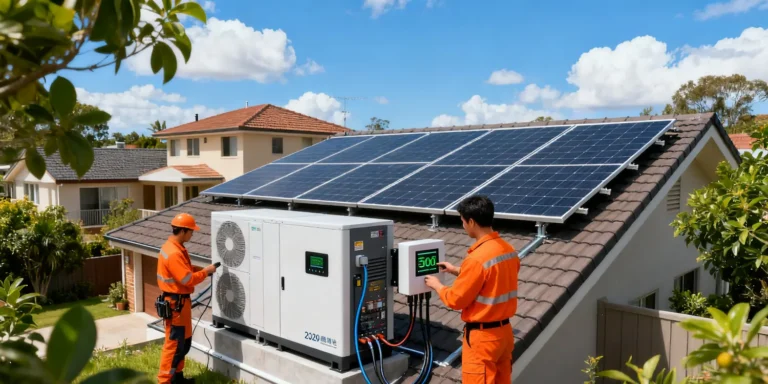
Insist on IP54 or better, because equipment will sit in a puddle at some point. Require true pass-through operation so the unit charges and supplies simultaneously without a transfer gap that would reboot a medical device. Choose systems that accept both generator AC and photovoltaic DC input, since folding solar arrays extend endurance indefinitely on a multi-week deployment. Finally, standardise on one platform across the cache. Interchangeable batteries, cables and chargers matter far more during a chaotic first 48 hours than any single specification on a datasheet.
People Also Ask
How large a battery does a shelter need? Plan on 0.2 to 0.3 kWh per occupant per day for basic lighting, charging and fans, then add medical and kitchen loads separately. A 400-person shelter usually lands between 80 and 130 kWh per day.
Can these systems run medical equipment? Yes, provided the inverter delivers a true sine wave and supports pass-through without interruption. Oxygen concentrators and CPAP machines are common shelter loads and both tolerate battery supply well.
How should units be stored between disasters? Keep them at roughly 30 to 50 percent charge in a cool, dry space and top them up every six months. LiFePO4 stored this way loses very little capacity across years of standby.
Are batteries safe to operate inside an occupied building? LiFePO4 systems produce no exhaust and no fuel vapour, so they are routinely used indoors. Provide clearance for airflow around the enclosure and keep charging equipment away from sleeping areas.
Written by Karl at China Battery Technology. Request a quote.
Related reading: Battery Solutions for Self-Service Kiosks: Reliable Unattended Power