Sodium-Ion Battery for Wind Farm Pitch Control: Cold-Weather Backup That Holds Up
Sodium-Ion Battery for Wind Farm Pitch Control: Cold-Weather Backup That Holds Up
When grid power drops, a turbine has seconds to feather its blades. The pitch backup supply is the last line of defence between a controlled shutdown and a runaway rotor, which is why operators inspect it obsessively and replace it early. A sodium ion battery changes that maintenance rhythm: it keeps usable power at temperatures where valve-regulated lead-acid has already lost half its capacity, and it tolerates the partial-state-of-charge float life that hub-mounted backup systems impose.
What the Pitch System Actually Demands
Each blade axis needs roughly 3 to 8 kW for 10 to 30 seconds to drive from operating angle to 90 degrees. That is a short, brutal discharge — often 5C or more on a small pack — repeated only a handful of times a year in anger, but tested monthly. Between tests the pack floats for weeks inside a rotating hub that swings from -30 °C in a Nordic winter to +55 °C behind a nacelle radiator in summer. Very few chemistries enjoy that life.
Where Lead-Acid Falls Down
VRLA blocks are cheap and familiar, and that is most of their appeal. At -20 °C a typical AGM block delivers around 55 percent of rated capacity, so designers oversize the string by nearly double just to survive a cold-start test. Float service at elevated temperature then dries the electrolyte and halves the calendar life. Most wind operators budget a three-to-four-year replacement cycle, and hub access means each swap costs far more in crane time and technician hours than the hardware itself.
The Sodium-Ion Case
Hard-carbon sodium-ion cells retain roughly 85 to 90 percent of rated capacity at -20 °C, and unlike lithium iron phosphate they can be charged at low temperature without lithium plating risk. They also tolerate being stored and shipped at zero volts, which removes a genuine logistics headache when packs travel to remote sites. For pitch backup the deciding factor is usually the combination of cold power and a calendar life measured in thousands of cycles rather than a few hundred.
Technology Comparison for Pitch Backup
| Technology | Capacity at -20 °C | Typical service life | Peak discharge | Notes |
|---|---|---|---|---|
| Sodium-ion | 85–90% | 8–10 years | 5–10C burst | Safe at 0 V storage, wide temperature band |
| VRLA AGM | 50–60% | 3–4 years | 3C with heavy sag | Lowest upfront cost, highest crane cost |
| LiFePO4 | 70–80% | 8–10 years | 5C burst | Needs heater for sub-zero charging |
| Ultracapacitor | >95% | 10 years+ | Very high | Excellent power, poor energy for long feather cycles |
Sizing a Hub Pack
Work from the worst case: full feather from operating pitch, at the coldest rated temperature, at end of life, with one cell string derated. A 48 V axis drawing 6 kW for 25 seconds needs about 42 Wh of delivered energy, but design margin, cold derating and 80 percent end-of-life retention push the nameplate to roughly 120 to 150 Wh per axis. Operators who also want a second attempt without recharge simply double that figure.
Vibration, Slip Rings and Mechanical Design
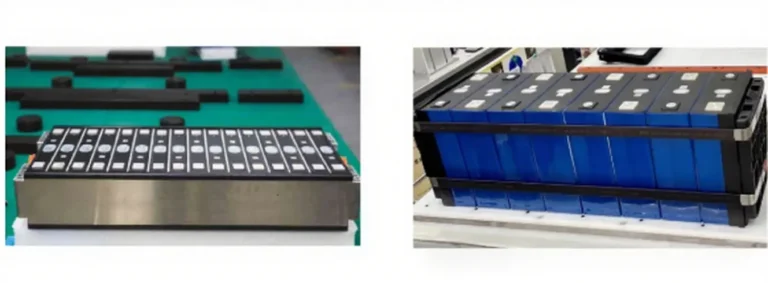
The hub is a rotating, vibrating box. Cells must be clamped, not merely stacked, and every conductor needs strain relief. We use compression-bonded prismatic modules with vibration testing to IEC 60068-2-6 across the 5 to 500 Hz band, and we specify torque-marked busbar joints so a technician can spot creep during inspection instead of finding it after a fault. Cable routing to the slip ring should avoid the pack entirely; noise coupled through charging leads is a recurring cause of nuisance BMS trips.
Monitoring and Test Regimes
A pitch backup that cannot prove itself is a liability. Specify a BMS that reports per-cell voltage, temperature and internal resistance over CAN to the turbine controller, and schedule an automatic partial-discharge self-test rather than a full one — repeated deep discharges shorten life without adding real assurance. Rising internal resistance is the earliest reliable warning that a module is drifting, usually visible months before a capacity test would flag it.
Commercial Reality
Sodium-ion cells currently sit close to LiFePO4 on price per kilowatt-hour, above lead-acid on day one. The economics come from avoided replacements: skipping two crane-supported swaps over a decade dwarfs the cell cost difference on almost every site we have quoted. For offshore assets, where a single technician visit can cost more than the entire pack, the calculation is not close.
People Also Ask
Can sodium-ion replace existing lead-acid pitch packs directly? Often yes in the same footprint, but the charger profile must change. Sodium-ion uses a different voltage window and will be undercharged by a lead-acid float charger.
How cold can these packs go? Our hub packs are rated -40 to +60 °C for discharge and -20 to +55 °C for charge, with usable power well below what VRLA can deliver.
What certifications apply? IEC 62619 for industrial cells, UN38.3 for transport, and turbine-level compliance with IEC 61400-1 vibration and environmental requirements.
Is fire risk lower than lithium? Sodium-ion has a higher thermal runaway onset temperature and no lithium plating pathway, which is why several operators now prefer it for enclosed hub installations.
Written by Karl at China Battery Technology. Request a quote.
Related reading: Sodium-Ion Battery for Offshore Platforms: Safer Remote Power