Sodium-Ion Battery for Flood Warning Systems: Cold-Weather Reliability
Sodium-Ion Battery for Flood Warning Systems: Cold-Weather Reliability
A flood warning station spends 99% of its life doing almost nothing and 1% of its life doing the most important job on the river. That duty profile — long idle periods, then a sudden demand for radio transmission and siren power, often in the worst weather of the year — punishes conventional batteries. A sodium ion battery handles it better than lithium or lead-acid because it keeps usable capacity when the cabinet drops below freezing and it does not degrade when parked at partial charge for months.
What a Flood Station Actually Draws
A typical river-level station combines an ultrasonic or radar level sensor, a rain gauge, a datalogger, and a cellular or LoRa radio. Average draw is small — 0.5 to 2 W — but the radio transmits in bursts of 1–3 A, and during an alert the reporting interval collapses from hourly to every two minutes. Sites with a siren or flashing beacon add a 50–150 W load that may run for an hour. Total daily energy sits near 30–60 Wh in standby and can jump tenfold during an event.
The Cold Problem Nobody Budgets For
Flooding in temperate regions frequently accompanies snowmelt and winter storms, so the battery is coldest exactly when it is needed most. Standard lithium-ion loses 20–30% of usable capacity at −20 °C and cannot be charged at all below freezing without a heater that consumes the very energy being conserved. Sodium-ion cells retain roughly 85–90% of capacity at −20 °C and accept charge at low temperature, which removes the heater from the power budget and the failure list.
Chemistry Comparison for Flood Telemetry
| Attribute | Sodium-ion | LiFePO4 | AGM lead-acid |
|---|---|---|---|
| Capacity at −20 °C | 85–90% | 60–70% | 50–60% |
| Charge below 0 °C | Yes | Needs heater | Reduced |
| Long storage at partial charge | Excellent | Good | Poor (sulfation) |
| Cycle life | 3000–4000 | 3000–6000 | 300–500 |
| Safe transport / shipping | Can ship at 0 V | Restricted | Unrestricted |
Pairing With Solar on Remote Banks
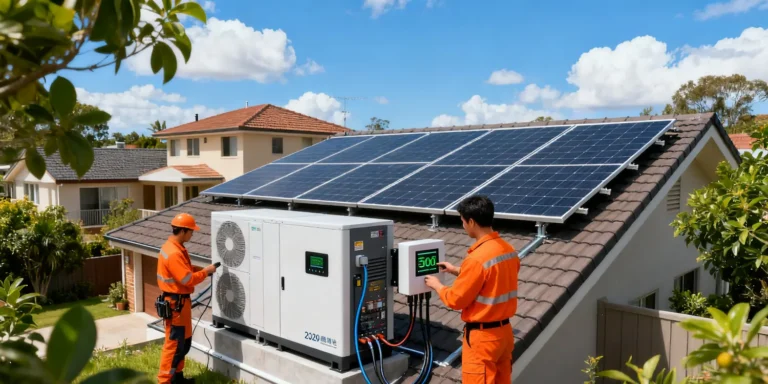
Most flood stations sit on riverbanks with no mains supply, so a 30–80 W panel does the charging. Size the battery for at least seven days of autonomy through overcast winter weeks, then add the event-mode surcharge. A 100 Ah 12 V sodium-ion pack gives about 1.2 kWh — comfortable margin for a standby load of 40 Wh per day plus a multi-hour alert. Because sodium-ion tolerates deep discharge without lasting harm, the station survives a longer solar drought than a lead-acid equivalent of the same nameplate size.
Enclosure and Installation Details
Mount the battery above the design flood level, not in the base of the pole cabinet where water collects. Use an IP66 enclosure with a breather vent to manage condensation, and fit the pack on a shelf rather than the floor so a leak does not immerse the terminals. Specify an integrated BMS reporting state of charge over Modbus or RS485 so the control room can see battery health remotely — discovering a dead station during a flood is not an option.
Maintenance and Lifetime Cost
Sodium-ion packs in telemetry service typically deliver eight to ten years before capacity falls below the design threshold, against two to three years for the AGM batteries many agencies still replace on a fixed cycle. Removing that replacement truck roll from remote sites — often reachable only by farm track or boat — usually dominates the business case more than the cell price itself.
People Also Ask
Is sodium-ion energy density enough for a monitoring station? Yes. At 120–160 Wh/kg it is below lithium, but weight and volume are not constraints on a fixed pole or cabinet, so the cold-weather and storage advantages dominate.
Can sodium-ion be shipped fully discharged? Yes, sodium-ion can be transported at zero volts, which simplifies air freight and spares logistics for agencies stocking replacement packs regionally.
How long can a station sit unused? Twelve months or more at partial charge with negligible degradation, which suits seasonal catchments that only run during a defined wet season.
Written by Karl at China Battery Technology. Request a quote.
Related reading: Sodium-Ion Battery for Offshore Platforms: Safer Remote Power