Sodium-Ion Battery for Electric Forklift: A Cold-Store Fit
Sodium-Ion Battery for Electric Forklift: A Cold-Store Fit
Warehouses and distribution centers are electrifying material handling to cut emissions and indoor pollution, and the sodium ion battery for forklift is emerging as a compelling option for operators who run in cold environments. Unlike lithium, a sodium ion battery keeps most of its capacity at low temperature without heaters, which matters in freezers, refrigerated docks, and unheated yards. For many fleets this chemistry simply fits the building better than lithium.
Why Forklifts Are a Tough Duty Cycle
A forklift draws heavy current during lift and travel, then rests while the operator picks or stacks. Traditional lead-acid demands watering, equalizing, and a long cool-down charge, which wastes floor space and labor. Lithium solved the opportunity-charging problem, but its cold-weather penalty pushed operations to add cabinet heaters. Sodium-ion removes that penalty, holding charge where lithium lags.
Cold Performance Advantage
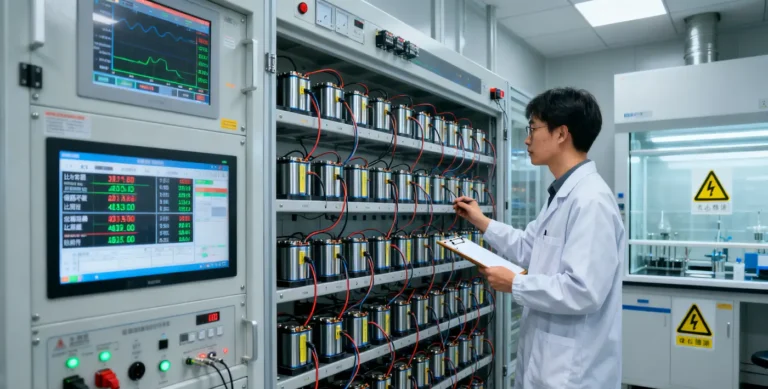
Sodium-ion cells retain 90%+ capacity at −20 °C, so a freezer-aisle forklift does not need a heated battery compartment or a power de-rate. That avoids the energy overhead of keeping a lithium pack warm and eliminates a common failure point. For multi-shift cold chains, the chemistry’s tolerance translates directly into consistent lift speed and fewer mid-shift swaps.
Forklift Battery Comparison
| Attribute | Sodium-Ion | LFP (LiFePO4) | Lead-Acid |
|---|---|---|---|
| Cold capacity (−20°C) | >90% | ~70% (+heat) | ~60% |
| Cycle life | 3000–6000 | 4000–7000 | 1000–1500 |
| Maintenance | None | None | Watering |
| Material cost | Lower | Medium | Low (short life) |
| Energy density | Medium | Medium | Low |
Sizing and Deployment
Match the pack to peak lift current and shift length, not just average draw; a freezer forklift spends more time at high current than a dock unit. Plan opportunity charging during breaks so a single pack covers a full shift. Because sodium-ion is newer in this role, qualify the supplier on cycle warranty, BMS communications (CAN/RS485), and proven cold-store references before a fleet-wide rollout.
Cost and Market Outlook
Sodium-ion sits at a slight energy-density disadvantage to LFP but wins on material cost and cold tolerance, and prices keep falling as volume scales. For cold-store operators the total cost of ownership is often lower once you remove heater energy and the productivity lost to lithium cold de-rate. Expect sodium to take a growing share of indoor, temperature-extreme material-handling fleets through 2026 and beyond.
What to Ask a Supplier
Request documented cycle life at your operating temperature, not just at 25 °C, and ask for the BMS communication protocol so it integrates with your fleet dashboard. Confirm the warranty covers cold-duty and partial-state cycling, and insist on a reference site with a similar duty profile. A supplier who cannot show cold-cycle data is not ready for freezer-aisle deployment.
People Also Ask
Is sodium-ion ready for industrial forklifts? Yes — early commercial deployments in cold storage and logistics are running in 2025–2026, with more suppliers qualifying each quarter.
When should I still choose lithium? If you need maximum energy density in a tight battery bay or operate mostly in warm climates, LFP remains the safe, proven pick.
Does it need a special charger? It uses the same CC-CV charging as lithium with a sodium-specific profile; most forklift chargers can be configured or swapped to match.
How do I size for a freezer versus a dock? Freezer forklifts spend more time at peak lift current and lower temperature, so size 20–30% larger on both energy and power than an equivalent dock unit, and confirm the BMS thermal limits before committing.
Written by Karl at China Battery Technology. Request a quote.
Related reading: Sodium-Ion Battery for Offshore Platforms: Safer Remote Power