Lithium Battery for Mining Equipment: Ruggedized Packs
Lithium Battery for Mining Equipment: Ruggedized Packs
Mining is the harshest environment a battery will ever face: shock, vibration, dust, water, explosive atmospheres, extreme temperature, and a duty that runs continuously in shifts. A pack that survives a warehouse will not survive a haul truck or an underground loader. This guide explains what “ruggedized” actually means for mining lithium packs, why the enclosure and certification dominate, and how to specify a battery that keeps producing instead of catching fire or failing underground. For a lithium battery manufacturer, mining is the ultimate proving ground, and the cells are the easy part.
What “ruggedized” really means
Ruggedized is not a thicker box; it is a system of design choices. The enclosure must meet IP67 or higher against dust and water ingress, resist impact from rock and equipment, and damp vibration so cells and welds do not fatigue. Internally, the cells are potted or mechanically isolated so a single impact does not short the string. The BMS must keep working through electrical noise from massive motors and survive the thermal and shock environment. A battery application solutions program for mining starts from the hazard map—what can hit, flood, heat or spark the pack—and designs backwards from there, because a generic pack simply will not last a shift.
Hazardous-area certification
Underground and some surface mining operate in potentially explosive atmospheres (methane, coal dust, diesel fumes), so the pack must carry the correct intrinsic-safety or flameproof certification for the zone. This is not optional and not the same as automotive or consumer marks. A non-certified pack in a gassy heading is a prosecution and a disaster waiting to happen. The cert covers not just the cells but the entire assembly—enclosure, connectors, BMS, and any venting—so the whole unit must be designed and tested as one approved article. A sodium-ion battery is intrinsically harder to thermal-runaway, which is genuinely attractive where gas ignition risk is the dominant hazard, but sodium’s lower density means a larger, heavier pack, and it is not yet certified for mining at volume, so LFP with proper flameproofing remains the practical route.
Typical mining duty and pack sizes
| Equipment | Pack size | Peak power | Key challenge |
|---|---|---|---|
| Underground loader (LHD) | 200–400 kWh | 300–600 kW | Explosive atmosphere, heat |
| Battery haul truck | 500–1,500 kWh | 1–3 MW | Weight, charging window |
| Drill rig | 100–300 kWh | 150–400 kW | Vibration, dust |
| Light utility / bolter | 40–120 kWh | 60–200 kW | Space, shock |
The table shows the scale: mining packs are among the largest mobile lithium systems made, and the peaks are enormous. A haul truck pack approaches a megawatt-hour and must deliver megawatts of peak. That size forces decisions about charging windows during shift changes and about cooling, because a 1 MWh pack generating heat at high C-rate needs serious thermal management or it will throttle and strand a loaded truck. The pack is no longer a component; it is a piece of mine infrastructure.
Thermal management underground
Underground, ambient heat from the rock and the equipment is high, and airflow is limited, so a mining pack needs active cooling—usually liquid—to hold cells in the safe band during a high-C discharge and an even higher-C fast charge between shifts. The cooling loop must itself be rugged and sealed, and the BMS must shed heat fast enough that the pack never hits its thermal ceiling mid-cycle. A home energy storage system builder’s thermal discipline transfers here, but mining demands an order of magnitude more heat removal, so the cooling design is a first-class engineering task, not a bolt-on.
Charging windows and opportunity charging
Mining equipment works in shifts, and the only practical charge window is the changeover, often 20 to 60 minutes. That demands very high charger power—hundreds of kW to MW—to refill a huge pack in a short slot. Some sites use battery swap for loaders so a depleted pack is exchanged for a charged one in minutes, keeping the machine moving while packs charge elsewhere. Swap adds infrastructure and a spare pack per machine but eliminates charging downtime. The choice hinges on the site’s power capacity and the value of continuous operation; either way the charger is a major capital item that must be specified with the pack, not after.
Why LFP dominates mining
LFP’s safety margin and cycle life make it the default for mining despite its lower density, because a heavy pack is acceptable on a vehicle designed to move tonnes, and the lower thermal-runaway risk is a real safety win in a gassy, confined space. NMC’s density would shrink the pack, but the fire risk underground is unacceptable for most operators. A semi-solid-state battery could offer LFP-class safety with more energy, easing the weight and space crunch on smaller machines, but it is not yet a mining-volume product and the certification path is unproven, so LFP with rigorous flameproofing is what gets deployed today. The chemistry decision is driven by safety certification, not by range.
Vibration, shock and mechanical isolation
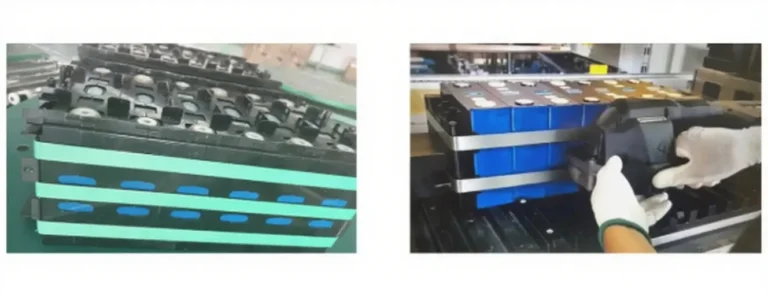
Mining machines shake hard and take impacts. Cells must be held in a frame that isolates them from the chassis frequency, and busbars and connectors must survive millions of cycles of micro-movement without fracturing. Potting the module in a compliant compound and using flexible links at the interfaces prevents the fatigue cracks that silently kill packs. The enclosure must also resist being crushed or punctured by rock and equipment. This mechanical engineering is where most “rugged” claims are won or lost, and a buyer should ask for the vibration qualification report by name rather than accepting a marketing adjective.
Telemetry and condition monitoring
Underground, a dead battery is not just inconvenient—it can block a heading and require a rescue tow. The BMS must report state-of-health, per-cell temperature and fault codes to the surface over the mine network, so maintenance can swap a weak pack before it fails. A lithium battery manufacturer with in-house firmware can tune alarms to the mine’s duty and push fixes, which matters when a fleet runs 24/7. Telemetry turns an unexpected failure into a planned swap during a shift change, and that difference is measured in tonnes of ore, not minutes.
Procurement and total cost
Mining packs are expensive, but the cost of a failure underground is far higher, so procurement must weight reliability and certification above sticker. Score on certified hazardous-area approval, demonstrated vibration and ingress qualification, delivered cycle life at the real depth-of-discharge, thermal performance at your peak, and the supplier’s reference deployment in a similar mine. Divide price by expected cycles for $/cycle and compare on that, because a cheaper uncertified pack is not a saving if it cannot legally enter the heading. Insist the warranty names cycles at depth-of-discharge and the certification covers the exact assembly. The disciplined buyer treats the pack as safety-critical infrastructure and buys accordingly.
Cost-of-ownership modeling
Mining packs are capital-heavy, so the buying decision should be modeled on total cost across the contract, not sticker. Capture energy cost, charger and swap-station amortization, cooling power, the probability and cost of a mid-contract failure underground, and pack replacement if it wears early. A pack that lasts the full mine plan at 80% depth-of-discharge avoids a replacement that can run six figures per machine and halts production. Divide pack price by expected cycles for a true $/cycle and rank bidders on that, because the cheapest quote usually carries the shortest certified life and the weakest support. The disciplined buyer treats the pack as mine infrastructure with a lifecycle budget, not as a consumable bought on price.
Second-life, recycling and closure
Mining operators face tightening rules on battery waste, and a huge pack retired at 80% capacity is a liability if dumped, or an asset if managed. Plan a second-life path—a smaller surface vehicle, a stationary buffer at the workshop, or a certified recycler who recovers cobalt, nickel, lithium and copper. Keep the BMS log and certification so the pack has a credible downstream owner, and choose a supplier with a take-back commitment written into the contract. Over a multi-year mine plan the managed end-of-life path turns a disposal cost into residual value and de-risks the closure paperwork, which matters when auditors examine the site’s environmental record.
Local support and spare modules
Underground, a pack failure that waits weeks for a part halts production, so the supplier’s local support matters as much as the spec. Require a stated response time, a stock of spare modules or cells at a regional depot, and firmware support that can push a fix to the mine’s network. A vendor who only ships from a distant factory is a single point of failure for your uptime. Ask for the reference site’s actual support experience, not the brochure promise, and build the spare-part holding into the contract so a fault becomes a same-shift swap rather than a stranded machine. Support is the difference between a pack that earns its keep and one that becomes a bottleneck.
Frequently asked questions
Which certification do I need? The hazardous-area approval for your zone (methane, dust, etc.); it must cover the whole assembly, not just cells.
Why LFP underground? Its lower thermal-runaway risk is a major safety win in confined, gassy spaces where weight is acceptable.
How do you charge such big packs? High-power chargers during shift change, or battery swap for loaders to keep machines moving.
What kills a mining pack? Vibration fatigue, dust/water ingress, and overheating if the cooling or BMS fails—mechanical ruggedness matters most.
Written by Karl at China Battery Technology. Describe your equipment, zone and shift window and we will engineer a certified pack—request a quote for a ruggedized mining battery.
Related Reading
- custom lithium battery manufacturer
- Lithium Battery for Wheelchair: Lightweight Mobility
- Lithium Battery for Portable Power Station: Camping and Job Site