How to Size a Battery for Off-Grid Living
How to Size a Battery for Off-Grid Living
Sizing a battery for an off-grid home is where most renewable-energy projects either succeed quietly or fail expensively. The error is almost never the cells—it is the arithmetic. Buyers pick a pack that covers a sunny-day average and discover in the first stormy week that the bank hits empty by midnight. This guide walks through a defensible sizing method: measure load, set autonomy, apply depth-of-discharge, derate for temperature, then choose chemistry and configuration. A lithium battery manufacturer can supply any of the chemistries below, but the duty cycle decides which one earns its place, and the numbers below are what separate a bank that carries you through winter from one that leaves you on a generator.
Start with your daily energy budget
Every off-grid size begins with a load audit. List every appliance, its watts, and the hours per day it runs, then total the watt-hours. A typical efficient cabin—LED lighting 120 W for 5 h, refrigerator 80 W running 8 h, water pump 400 W for 0.5 h, laptop 60 W for 4 h, and a 300 W well pump cycling 1 h—comes to roughly 4.3 kWh/day. Do not trust nameplate ratings; measure with a plug-in meter for a week, because phantom loads from inverters, routers and chargers routinely add 0.5–1 kWh/day that the paper budget misses. The daily energy figure, not the panel size, is the anchor of the whole calculation, and a sloppy audit propagates through every later step, multiplying errors at each stage until the installed bank is quietly half the size it should be. Spend a week logging and you save a five-figure mistake.
Decide autonomy in days
Autonomy is how many sunless or windless days the bank must cover without the charge source. A grid-free cabin in a cloudy region needs 3–5 days; a sunny desert site with a generator backup may need only 1–2. Multiply daily kWh by autonomy days to get the raw energy the bank must hold. For the 4.3 kWh/day cabin wanting 3 days, that is 12.9 kWh of required storage. This single multiplier is the difference between a bank that survives winter and one that leaves you running an extension cord to the neighbor—so size it honestly against your worst realistic weather, not the brochure climate. Many buyers pick one day to save money and then discover that their “worst case” happens every February, which is exactly when the bank is needed most and performs worst due to cold.
Convert to usable capacity with depth-of-discharge
No bank should be drained to zero. Lithium (LFP) is safely cycled to 80–90% depth-of-discharge; lead-acid to only 50%. Divide required energy by usable DoD to get nameplate capacity. At 90% DoD, 12.9 kWh needs 14.3 kWh nameplate; at 50% DoD (lead-acid), the same duty needs 25.8 kWh nameplate—nearly double the cells for identical service. This is the first place lithium’s economics beat lead-acid: you buy roughly half the bank for the same delivered energy. A home energy storage system designed for off-grid duty should always quote usable kWh, not nameplate, because usable is what keeps the lights on and nameplate is what lets a vendor’s quote look smaller than it performs in the field.
Worked example: a 2 kW off-grid cabin
Take a 2 kW inverter feeding the 4.3 kWh/day load with 3-day autonomy and 90% DoD. Required storage = 4.3 × 3 = 12.9 kWh; nameplate = 12.9 / 0.9 = 14.3 kWh. At a 48 V bank, that is 14,300 Wh / 48 V ≈ 298 Ah. Round to a standard 300 Ah 48 V LFP rack. Add 10% for wiring and conversion losses and the bank is about 330 Ah. Note this assumes the charge source can refill it; if the solar array is undersized, no battery size fixes a generation deficit. The number is only as good as the load audit and autonomy choice feeding it, which is why those two steps deserve the most scrutiny. Re-run the arithmetic at 80% DoD instead and the bank grows to 367 Ah—still far below the lead-acid equivalent of 25.8 kWh, which at 48 V would be a 538 Ah monster that occupies twice the floor space and needs watering for its life.
Voltage and bank configuration
Off-grid inverters commonly run 12 V, 24 V or 48 V. Higher voltage means lower current for the same power, so thinner cables and smaller losses—a 48 V bank carrying 2 kW pulls ~42 A, while a 12 V bank pulls ~167 A and needs heavy, costly copper. Size the bank as series strings of cells to reach the inverter voltage, then parallel strings for capacity. A 48 V 300 Ah bank is typically 16 LFP cells in series repeated as needed. Confirm the BMS can manage the series count and that parallel strings stay balanced; mismatched strings quietly cap usable capacity. The voltage decision is an installation-cost decision as much as a battery decision, and the labor saving of running 4 AWG instead of 2/0 between battery and inverter often pays for the higher-voltage components within a single build.
Size the charge source to the bank
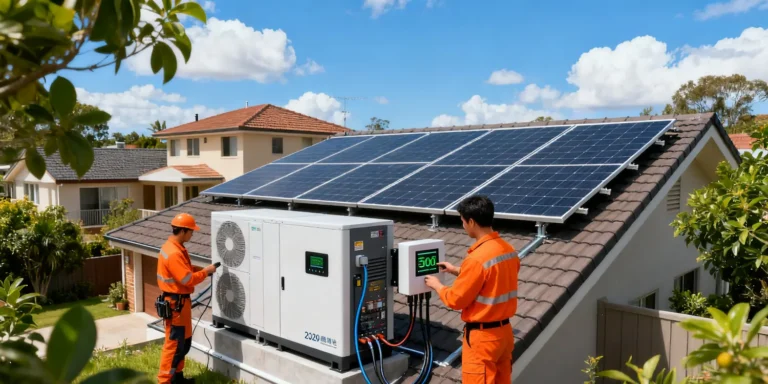
The panels or wind turbine must replace daily draw plus cover autonomy refill. To refill a 12.9 kWh bank over two sunny days after a storm, you need ~6.5 kWh/day of generation, but winter sun may deliver only 3–4 peak-sun hours, so a 2 kW array is reasonable. Undersizing the array forces deeper discharges that age the bank; oversizing wastes money. A battery application solutions engineer will match array, charge controller and bank as one system rather than buying each in isolation, because the three must agree on voltage and current or the weakest link governs. The charge controller’s own efficiency—typically 92–97% for MPPT—is another 3–8% the naive model forgets, and over a year that loss is real energy you must generate and store.
Inverter and converter losses
The inverter that turns DC into AC is not free. A 2 kW pure-sine inverter draws 0.3–0.6 A continuously just to stay awake, and its conversion efficiency falls to 80–85% at very light loads where most off-grid homes actually sit overnight. That standby and light-load loss can add 0.4–0.8 kWh/day to your real draw, which the battery must supply. Size the bank with this loss baked in, and choose an inverter whose efficiency curve is flat at your typical load, not just its headline 95% at full power. A bank sized on inverter nameplate alone routinely comes up short by the exact amount of these ignored losses, which is why the closing paragraph of any honest sizing guide repeats: measure, do not estimate.
Temperature and cold derating
Lithium LFP loses capacity and, more importantly, must limit charge below 0 °C to avoid plating. An unheated outbuilding bank in winter needs either a warmed enclosure or low-temperature charge management. Sodium-ion tolerates cold better and is worth considering for unheated sites, while lead-acid collapses in cold and needs oversizing. A sodium-ion battery for an off-grid cabin in a snowy climate removes the heater-mat load and the cold-charge trip, at the cost of a larger footprint for the same energy. Match chemistry to where you will actually place the bank, because a cold placement effectively shrinks the usable kWh you paid for, and location is a sizing input rather than a cosmetic detail.
BMS and protection for off-grid banks
The BMS is non-negotiable on lithium: over-voltage, under-voltage, over-current and temperature cutoffs keep the bank alive through years of unattended cycles. For a distributed 48 V bank, active balancing preserves capacity across strings better than a passive bleed. Verify the BMS reports state-of-health over the inverter bus so you can see a weakening cell before it strands you. A semi-solid option is not needed here—stationary off-grid duty is low C-rate, where plain LFP or sodium wins on cost—but a semi-solid-state battery could shrink a space-constrained install if footprint, not weight, is the constraint, and for a cabin where the battery must fit a narrow wall cavity that density can matter more than the dollar-per-kWh premium.
Chemistry comparison for off-grid
| Chemistry | Usable DoD | Cold charge | Cycles | Off-grid fit |
|---|---|---|---|---|
| LFP (lithium) | 80–90% | Limited below 0 °C | 3000–6000 | Best all-round value |
| Sodium-ion | 80–90% | Stronger cold tolerance | Emerging | Cold, unheated sites |
| Lead-acid | 50% | Poor when cold | 500–1000 | Cheap upfront, short life |
The table shows why LFP dominates off-grid: high usable DoD and long life mean a smaller, longer-lived bank. Sodium earns a niche in cold unheated installs; lead-acid only wins on lowest sticker price and loses on total cost within two years. For a buyer comparing quotes, the honest metric is cost per delivered usable kWh over the system’s life, and on that basis LFP is rarely beaten except where cold charging is the binding constraint and sodium’s tolerance earns its footprint penalty.
Generator hybrid sizing
Many off-grid homes pair a small generator with a smaller battery to cover multi-day storms cheaply. Instead of sizing the bank for five autonomy days, size it for two and let a 2–3 kW generator refill during extended outages. This can cut the battery by half while keeping resilience, because the generator covers the rare event the solar cannot. The trade is fuel, noise and maintenance, but for remote cabins the hybrid is usually the rational design. Model the generator run-hours against the extra battery cost; the crossover is typically at two-to-three autonomy days, beyond which batteries get expensive faster than a generator does, and a disciplined buyer stops adding cells at that point.
Common off-grid sizing mistakes
- Auditing loads from nameplate instead of measured watts.
- Setting autonomy to one day to save money, then failing in the first storm.
- Quoting nameplate capacity instead of usable capacity.
- Forgetting inverter and standby losses (typically 8–12%).
- Undersizing the solar array so the bank never refills.
- Ignoring cold-charge limits in unheated locations.
- Omitting the generator hybrid option and overbuying batteries.
Procurement checklist
Before you request quotes, lock these numbers: measured daily kWh, autonomy days for your climate, usable DoD, bank voltage, required nameplate Ah, and charge-source size. Hand that sheet to suppliers and ask each to confirm the pack at your peak C-rate with margin. Request the cycle-life data at 80% DoD and the UN38.3 Test Summary naming your exact model. A supplier who maps your numbers to a specific BMS and cell rating is ready to serve; one who only quotes a generic amp-hour number is guessing. The checklist converts a vague “I need a big battery” into a comparable, enforceable specification, and it is the document you will wave at a warranty claim three years later when a cell underperforms.
Monitoring and second-life planning
Once installed, log throughput via the BMS so you can see capacity fade and plan replacement before a failure. An LFP bank that reaches its rated cycles often still holds 70–80% capacity and makes a fine lower-duty second bank or a sellable second-life unit. Documenting the cycle and temperature history turns end-of-life from a cost into a managed asset and strengthens any resale value. The buyers who get the most from an off-grid bank are not those who bought the biggest pack but those who measured their duty, operated within it, and tracked the result—cycle life is mostly discipline wearing a chemistry costume, and the discipline is yours to keep regardless of which cells you purchased.
Frequently asked questions
How many days of autonomy do I need? Three is a safe minimum for cloudy regions; one to two only if you have a generator or very reliable sun.
Why not just buy the biggest bank? Oversizing wastes capital and still fails if the charge source cannot refill it; right-size to load and autonomy.
Is lead-acid cheaper for off-grid? Lower sticker, but 50% usable DoD and short life make it the most expensive per delivered kWh within two years.
Can I use sodium-ion off-grid? Yes, especially in cold unheated sites where its cold tolerance removes heater loads and charge-limiting trips.
Written by Karl at China Battery Technology. Send us your load audit and we will size the bank—request a quote for a configured off-grid system.
Related Reading
- battery application solutions hub
- Battery Runtime Calculator: Sizing for Autonomous Loads
- How to Choose Lithium for Your RV: A Step-by-Step Method