Battery Application Solutions for Police Station
Battery Application Solutions for Police Station
A police station is one of the few buildings that has to keep running at the exact moment the grid fails. Storms, vehicle strikes on a feeder pole and public-order incidents tend to arrive together, and the station must stay on air, stay lit, keep its holding areas supervised and keep its evidence secure through all of it. Battery application solutions for this building type start from a different question than a commercial office: not how much energy the site uses, but which circuits must never see a gap, and for how long the building can be defended if the outage runs into a second shift.
The Critical List Comes First
Not everything downstream of the panel matters equally. The dispatch and radio rack, computer-aided dispatch terminals, holding-cell doors and intercom, booking-area lighting, evidence refrigeration, exterior and sally-port lighting, and the CCTV and body-camera docking stack are the circuits that count. Training rooms, the gym, the canteen and non-essential office lighting are load-shed candidates. A defined critical bus is usually a third of the building’s connected load.
Dispatch Cannot Wait for a Generator
A standby set that takes fifteen to thirty seconds to reach rated voltage is not an answer for a dispatch position. Servers reboot, the radio rack drops its link, and the crew spends the first minute of an incident re-establishing comms. Storage on a static transfer switch holds the bus continuously, so the transition is invisible; the generator then becomes a second stage for long outages rather than the thing catching the first few seconds.
| Attribute | Battery + static transfer | Genset only | UPS + genset |
|---|---|---|---|
| Time to full power on outage | Instant | 15–30 s | Instant |
| Standalone autonomy | 4–12 h | Fuel-limited | 5–15 min |
| Routine service visits per year | 1–2 | 4–12 | 2–4 |
| Noise and exhaust on site | None | High | Moderate |
| Handles short repeated dips | Yes | Poorly | Yes |
Holding Areas and Life Safety
Cells carry obligations that ordinary backup does not. Door controls, intercom, lighting, CCTV and often ventilation and temperature limits must hold for as long as people are held. Define autonomy in hours against a stated occupancy, and confirm the panel arrangement keeps the cell block energised when non-essential floors are shed.
Sizing From a Real Load Audit
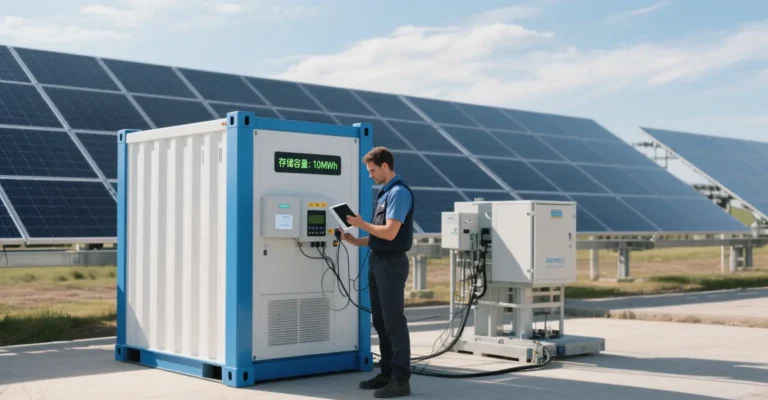
Do not size from the utility bill. Log the critical panel at one-minute resolution for two weeks, covering a weekend and a night shift; a station’s profile is flat and its peaks come from HVAC, fleet EV chargers and the drying room. Inverter size follows the worst sustained fifteen-minute window on the critical bus, and energy follows autonomy — most stations land between 60 kWh and 250 kWh.
EV Fleet Charging Changes the Answer
Marked units leaving for a shift with a flat battery is an operational failure, and a station with ten or twenty vehicles on managed chargers has a load that can be shaped. Put charging on the controllable side: pause it during an outage, resume it when the grid returns or the bank is above a reserve threshold. That single control decision often cuts the required inverter rating by a third.
Physical Security and Siting
Site enclosures inside the secure perimeter, in a locked plant room or a caged compound with CCTV coverage, away from public parking and the sally port. Confirm the ventilation path, the cable route to the main board, and that service access does not require escorted entry to a restricted area.
Municipal Procurement and Funding
Public-safety projects are bought on documentation. One tender package with a single-line diagram, cell and pack certification, thermal containment evidence, a ten-year degradation curve, autonomy stated at end-of-life capacity, and a commissioning report will move through approval. Incomplete packages lose a budget cycle, and resilience grants require autonomy stated against a named critical load, not the whole building.
What to Ask a Supplier
Ask for autonomy stated at end-of-life capacity rather than nameplate, the transfer time under load, the load-shed logic and who configures it, a reference site in a public-safety building, and the commissioning report format.
People Also Ask
How many hours of autonomy should a station plan for? Eight to twelve hours on a properly defined critical bus is typical, with a generator or portable connection covering anything longer.
Can storage replace the standby generator? It usually replaces a large one. Most stations keep a smaller set for multi-day events but find it runs a small fraction of its previous hours.
Does the fleet charging load have to be backed up? No. Managed chargers should pause automatically during an outage and resume when the bank is above its reserve, which keeps the critical bus small.
What maintenance does the system need? An annual inspection covering terminations, ventilation and a full discharge test, plus remote monitoring that flags cell drift before it becomes a fault.
Written by Karl at China Battery Technology. Request a quote.