Sodium Ion Battery for Port Terminal Shuttles: Fleet Duty, Cold and Total Cost
Sodium Ion Battery for Port Terminal Shuttles: Fleet Duty, Cold and Total Cost
Port terminals are a strange power market. Vehicles run eighteen hours a day, they charge in twenty minutes between crane moves, they live in salt air, and their duty profile is dominated by stop-and-start acceleration rather than sustained cruise. That combination has pushed a lot of terminal operators to look hard at a sodium ion battery for port terminal shuttles, because sodium chemistry’s weaknesses — lower energy density and lower volumetric efficiency — matter much less when the vehicle is a four-seat shuttle with a 6 hour shift and the battery bay is shaped by the chassis rather than by the chemistry. Compared with a lithium battery manufacturer’s usual lithium iron phosphate pack, sodium-ion trades roughly 15 to 25 % less energy per kilogram for material cost that is far less exposed to lithium carbonate prices, and for a fleet that is purchased every three to five years that trade is often the right one.
This article covers the duty profile of a terminal shuttle, what sodium-ion actually delivers at the pack level, how it behaves in the salt-laden and cold environment of a working quay, the certification route, and a worked sizing case for a 30-passenger electric shuttle.

What a terminal shuttle asks of a battery pack
An electric shuttle on a container terminal does not drive much distance. A typical automated or manned shuttle moves between 25 and 45 km per shift, but it accelerates hard maybe 150 to 250 times a shift, with peak traction currents of 250 to 500 A for four to eight seconds. Regenerative braking recovers maybe 18 to 25 % of that energy, so the net traction energy per shift is close to 14 to 20 kWh for a 30-passenger vehicle. Add accessories — heating, air conditioning, the terminal’s radio and camera suite, and in some cases a 2 kW work light for night moves — and you are at roughly 20 to 26 kWh per shift, with a top-up window of 15 to 25 minutes and a fast-charge window that can be as short as 600 A at 400 V.
That profile is brutal for lead-acid and gentle for sodium-ion. Lead-acid cannot absorb a 3C regen pulse and will gas; lithium can absorb it but pays with lithium plating risk if the pack is already near full; sodium-ion absorbs the same pulse with a voltage excursion of only a few tens of millivolts because of its steeper open-circuit curve at high state of charge, and it tolerates the repeated partial charge window without surface plating. The reason is in the electrochemistry: sodium ions shuttle between a layered oxide or polyanionic cathode and a hard-carbon anode that operates at a very low, nearly flat potential, so the metallic plating threshold sits far outside the normal operating window.
What sodium-ion gives you at the pack level, with numbers
Commercial sodium-ion cells intended for mobility now sit around 140 to 165 Wh/kg at the cell level and 115 to 140 Wh/kg at the pack level — roughly 20 % below a LiFePO4 pack of 150 Wh/kg cell / 125 Wh/kg pack, and closer to 35 % below an NMC pack. On volumetric density the gap is wider: 320 to 380 Wh/L for sodium-ion pack hardware versus 400 to 460 Wh/L for a well-packed lithium iron phosphate module, which is why a sodium pack in the same footprint gives you 18 to 22 % less usable energy. For a shuttle whose battery bay is volume-limited, that is the number that decides the vehicle’s range, not the mass figure.
| Factor | Sodium-ion pack | LiFePO4 pack | Lead-acid pack | Impact on a port shuttle |
|---|---|---|---|---|
| Specific energy | 115–140 Wh/kg | 125–150 Wh/kg | 30–40 Wh/kg | 6–8 % fewer kWh per tonne of pack |
| Energy density (volumetric) | 320–380 Wh/L | 400–460 Wh/L | 80–120 Wh/L | Bigger bay needed; smaller than lead-acid |
| Cold discharge at −20 °C | 92 % of room-temperature capacity | 78 % | 55 % and poor cranking | Key advantage on northern quays |
| Cold charge acceptance | Charge to 100 % at 0 °C at 0.5C | Requires warm-up or 0.02C limit | Impossible below −5 °C | Overnight winter charging works unheated |
| Cycle life (80 % DoD) | 4000–6000 cycles | 6000–8000 cycles | 1200–1800 cycles | Ok for 3–5 year shuttle replacement cycle |
| Round-trip efficiency | 88–91 % | 90–93 % | 75–82 % | Better than lead-acid on partial charge |
| Flat charge voltage plateau | Steeper near full, easier to gauge | Very flat, needs coulomb counting | Steep, easy gauge | State-of-charge accuracy is a real plus |
| Cost per kWh at pack level | Often 20–35 % less than Li-ion at 2026 volumes | Reference | Cheap but short life | Driven by sodium carbonate, not lithium |
Cold, salt and vibration: the quay environment
A shuttle that works the early shift on a North Sea terminal starts at −15 °C with the cab still empty and the defrosters at full draw. Lithium iron phosphate in that state cannot accept its normal charge current; the BMS is forced to taper charge to a trickle to protect the graphite anode, and you lose the overnight window. Sodium-ion’s hard-carbon anode does not have that constraint — it can accept 0.5C at 0 °C and reach full charge without a warm-up cycle, which means an unheated depot bay is viable. Operators in Scandinavia and Canada report that this single property removes an entire maintenance task: no battery warm-up procedure, no depot heating, no winter-range penalty beyond the modest physics of internal resistance rising about 20 % at minus temperatures.
Salt is the second factor and it is mostly a corrosion and enclosure problem rather than a chemistry problem. Sodium-ion chemistry is more tolerant of overcharge and of marginal cell balancing than NMC, but the pack enclosure still has to be IP67 with marine-grade connectors, and the electrolyte itself is water-based in most current sodium-ion cells, which brings its own fire profile. Standard cells are not flammable in the lithium sense, but a water-based electrolyte means an internal short can still heat the pack, so thermal propagation barriers and a temperature-fuse per cell group remain sensible. Seawater intrusion into a pack bay is an everyday risk at a terminal — washdown hoses, salt spray on a low-deck shuttle — so the enclosure rating and the drainage path behind the pack tray should be specified before the chemistry is chosen.
Certification and transport
Like every lithium or sodium cell shipped commercially, sodium-ion cells and packs move under UN38.3, and the same test manual governs them. For vehicular installation, ISO 12405 covers traction battery pack safety requirements, and the vehicle’s whole electrical system has to satisfy ISO 6463 for electric road vehicles where the pack is permanent equipment. For the pack’s own safety documentation, IEC 62619 remains the reference for stationary and industrial-type batteries, and IEC 62477 applies to the power conversion equipment around it. If the shuttle is exported between countries, check whether the destination’s EV homologation accepts sodium-ion: the chemistry is now accepted under the same UN vehicle regulations as lithium, so in practice the question is whether your supplier holds type-approval documents for the cell chemistry, not whether sodium-ion is permitted at all. On the cost side the independent data is useful to quote in a business case: the BloombergNEF publishes an annual cell price survey and has repeatedly flagged that sodium-ion undercuts lithium iron phosphate once sodium carbonate and hard-carbon anode supply stabilise, while the U.S. Department of Energy keeps the materials and chemistry reference most fleet planners start from.
Sizing a 30-passenger terminal shuttle
Worked example. A 30-passenger shuttle has a mass of 6 200 kg kerb, a 30 km per shift duty, an average traction power of 42 kW and a peak of 180 kW for 6 s during an unloaded acceleration with a full cabin. Traction energy per shift is 42 kW×1.2 h, less regeneration at 20 %, so about 40 kWh; accessories add 9 kWh; total 49 kWh with a 25 % reserve means a 65 kWh usable requirement. At a sodium-ion pack level of 130 Wh/kg that is 500 kg of cells, and with the enclosure, cooling and structure the pack lands near 720 kg. The same requirement in LiFePO4 at 135 Wh/kg gives you 480 kg of cells and a 660 kg pack. The lithium pack is 60 kg lighter and sits 15 kWh higher in usable energy for the same footprint only if the bay is volume-limited; if the bay is mass-limited instead, sodium-ion actually fits more energy inside the weight budget. Terminals that are weight-sensitive on bridge and ramp load ratings therefore should not dismiss sodium-ion on mass alone.
Charging: fast top-up without a thermal problem
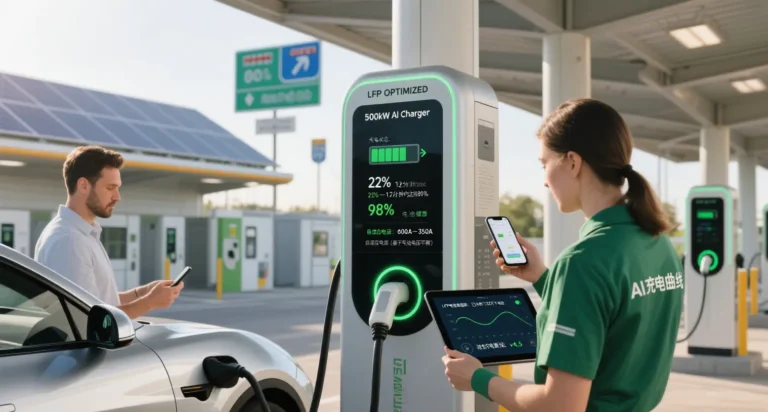
The 20-minute turnaround is where sodium-ion is quietly strong. Current capability for sodium-ion cells sits near 2C continuous discharge and 1.5C to 3C charge at 25 °C for the polyanionic chemistries, and the low-temperature charge tolerance means the depot does not need to run conditioning cycles. In lithium packs, the same 20-minute window forces a charge curve that hugs the anode-plating limit and generates more heat per minute, which is precisely why lithium fast-charge fleets need active liquid or refrigerant cooling. A sodium-ion pack on the same charger dissipates less heat for the same delivered power, so an air-cooled pack can often meet the same window as a liquid-cooled lithium pack — a meaningful cost and maintenance difference across a fleet of thirty shuttles.
People Also Ask
Is sodium-ion safe enough for a passenger shuttle? Yes. Most commercial sodium-ion cells use a water-based electrolyte with an organic cathode, and they do not run away thermally the way nickel-rich lithium cells can. That said, the pack still needs a battery management system, cell-level fusing and an enclosure rated for the environment; safety comes from the pack design, not the chemistry alone.
How does sodium-ion compare with lithium for a port shuttle in winter? It is the strongest argument for sodium. A sodium-ion pack discharges at roughly 92 % of its room-temperature capacity at minus 20 °C and can still charge at full rate, while a lithium iron phosphate pack needs a warm-up cycle or a heavily reduced charge current below 0 °C. For unheated northern depots this removes a whole winter maintenance procedure.
Does sodium-ion last long enough for a fleet replacement cycle? For mobility duty with 80 % depth of discharge, expect 4000 to 6000 cycles, which covers the three to five year replacement cycle most terminal shuttles follow. It is shorter than LiFePO4’s 6000 to 8000, but if the sodium pack is also cheaper at the point of sale and survives the winter charging regime without penalty, the lifetime cost per shift is comparable.
Should we specify sodium-ion for new shuttle orders today? If your depot is unheated, your turnaround window is under twenty minutes, or your battery bay is mass-limited rather than volume-limited, sodium-ion is a serious candidate and in some fleets the better one. If you need maximum range from a fixed volume or you already run a liquid-cooled lithium fleet with spare spares on the shelf, the lithium path is lower integration risk for roughly 15 % more pack cost.
Written by Karl at China Battery Technology. Request a quote.