Lithium Battery for Mobile Surveillance Trailers: Off-Grid Security That Starts on Time
Lithium Battery for Mobile Surveillance Trailers: Off-Grid Security That Starts on Time
A solar surveillance trailer is a small off-grid power plant that has to keep a camera pointed at the same patch of ground for an entire season. The unit parks in a field, a quarry edge or a construction compound, raises a six metre mast, and runs a camera, a radio link, a radar or thermal sensor and a lighting beacon off a roof-mounted panel with no grid connection and nobody within radio range for weeks. The failure that ends a deployment is almost never the camera; it is the pack that came back from the shop at 30 percent state of charge and never recovered. Getting this right means starting from a real watt-hour audit rather than a rule of thumb, and working through the bus voltage, the charge controller, the seasonal insolation you actually get at that latitude and latitude, and the way a lithium pack behaves through a long grey winter. A specification that holds up on a lithium battery manufacturer datasheet is below.

What a Security Trailer Actually Draws
Load audit first, because every sizing error downstream traces back to a guessed number. A mid-size mobile surveillance rig carries a 4K PTZ camera at roughly 12 to 18 watts, a 4G or 5G router at 6 to 10 watts, a long-range WiFi or licensed radio at 4 to 8 watts, an LED floodlight array of 40 to 120 watts on a motion or dusk timer, and a mast winch and lure speaker drawing 200 to 600 watts for the fifteen seconds it takes to erect. Add a small fan or heater for the enclosure in winter. The permanent load therefore sits at 25 to 45 watts continuously, with nightly spikes of 90 to 180 watt-hours for lighting. A rural deployment week where the camera runs 24/7 at 35 watts average consumes 5.9 kilowatt-hours, and if the floodlights fire for four hours a night at 90 watts that becomes another 2.5 kilowatt-hours, so roughly 8.4 kilowatt-hours a week. That is the number the pack has to be sized around, and it is far smaller than most buyers expect, which is the good news.
Why Lithium Beats Flooded Lead-Acid on a Trailer
Lead-acid is still specified on surveillance trailers out of habit, and it fails this duty in three predictable ways. First, usable capacity: a deep-cycle flooded battery quoted at 100 amp-hours is realistically 50 percent usable if you want any cycle life at all, so the 1.2 kilowatt-hour bank delivers 0.6 kilowatt-hours, while a lithium pack of the same weight delivers its full nameplate. Second, the solar charge cycle: a lead-acid bank wants a bulk, absorption and float profile and will sit gassing if a solar controller misapplies a lithium profile, whereas an LFP bank is comfortable floating at 13.6 volts for weeks, which is what a trailer does through a long sunny period. Third, self-discharge and standing losses: a lead-acid bank sitting unused for a month in a cold field loses 5 to 8 percent a month and then sulfates; an LFP pack loses under 2 percent and, more importantly, survives that standing period without capacity fade. On a unit that sits idle between deployments, that difference alone is worth the premium.
Architecture: 12 V, 24 V and Where 48 V Appears
Most surveillance trailers are 12 volt or 24 volt DC because the cameras, the lights and the mast pump are all live in the trailer harness. A 12 volt system is the simplest to wire and the most common on single-camera units, but at 35 watts it already carries 3 amps, and a 120 watt lighting load pulls 10 amps, so cable run losses and voltage sag across a five metre harness start to matter. Moving to 24 volt halves the current and is the right default for any rig with a mast winch or a high-power thermal camera. The rule of thumb is to keep the continuous current under 5 amps at the pack: below that 12 volt is fine, above it, go 24. Lithium makes this easy because a 24 volt pack can be built from 8 prismatic LFP cells in series at a 25.6 volt nominal, or from two 12 volt modules in series, whereas lead-acid 24 volt banks cost nearly double the 12 volt equivalent for the same amp-hour rating because of the extra plates.
Sizing the Pack With a Worked Example
Take a typical deployment: 38 watts average continuous, 90 watt floodlights for four hours a night, five rainy days a week in winter, and a target of seven days of full autonomy. Daily consumption is 38 times 24, which is 912 watt-hours, plus 360 watt-hours of lighting, so 1.27 kilowatt-hours a day. Seven days is 8.9 kilowatt-hours. Add a 20 percent derate for cold capacity and ageing and you order 11 kilowatt-hours of nameplate, which is a 200 amp-hour 24 volt pack or a 400 amp-hour 12 volt pack. Compare that with the lead-acid answer: a 24 volt 200 amp-hour flooded battery gives only 2.4 kilowatt-hours usable inside its 50 percent window, so you would be buying four times the lead-acid for the same resilience and hauling four times the weight at 60 kilograms per battery. On weight alone a lithium 11 kilowatt-hour pack is around 100 kilograms against 240 kilograms of lead-acid, which matters on a single-axle trailer with a 750 kilogram payload limit.
Solar Panel and MPPT Matching
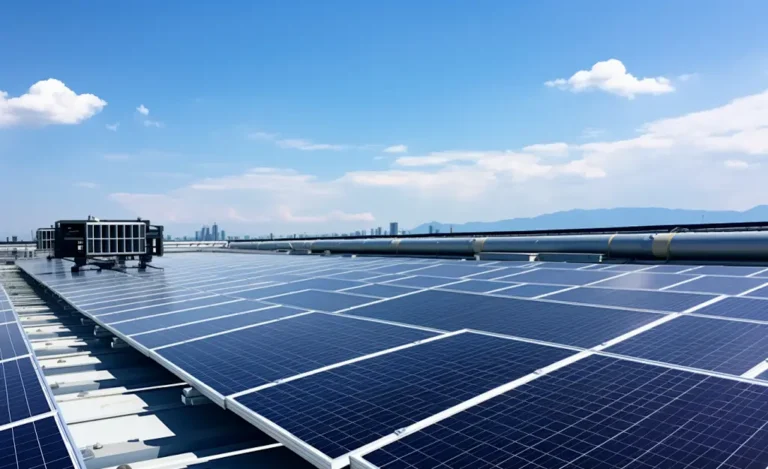
The array must be able to replace the daily deficit in the worst month, not the average one. Using the example, 1.27 kilowatt-hours a day replaced with four hours of effective sun in December needs 318 watts of peak panel, and a sensible margin means a 450 to 550 watt bifacial panel on the roof. A typical 550 watt panel delivers about 2.2 kilowatt-hours on a good December day at 34 degrees latitude, and 5 to 6 kilowatt-hours in July, so the pack charges fast in summer and slowly in winter, which is exactly the seasonal swing the BMS has to absorb. Use an MPPT controller sized at 1.5 times the panel short-circuit current: a 550 watt 24 volt panel has a short-circuit current near 18 amps, so a 30 amp MPPT is the correct minimum. Beware the cheap PWM controllers sold with trailers; they throw away 20 to 30 percent of the harvest by clamping charge voltage rather than tracking the panel’s maximum power point, and on a seasonal site that lost energy is a pack that dies in February.
Enclosure, Thermal and Vandal Resistance
The pack inside a surveillance trailer lives in the worst environment a battery can see. It sits in a locked steel locker under a mast base, in summer it sees internal temperatures of 50 to 60 degrees because the sun bakes the roof and the locker has no vent path, and in winter it sees minus 20. Specify an LFP pack rated for continuous 60 degrees and charge down to 0 degrees at minimum, with the charger temperature-compensated, never a pack that is only rated for 45 degrees. Charge below zero on lithium plating risk, so the BMS or the controller must block charging at 0 degrees and simply let the pack sit. Venting is a real design question: LFP does not vent hydrogen like lead-acid, but a sealed metal locker still needs a small filtered vent to equalise pressure and to stop moisture wicking into the cell terminals, and a desiccant pack replaced annually is a cheap insurance policy. Locking is not optional either; a trailer pack is a theft target, and the pack should be bolted to the tray through the locker floor with the Communication cable in a shielded conduit.
Commissioning, Monitoring and Standards
Commission with a full charge, then record the state of charge and the cell spread in writing. Monitor the pack by SMS or a short-message cellular link at least once a day, alerting below 40 percent state of charge in autumn so a deployment can be serviced before the winter deficit turns into a dead bank, and alerting on any cell that drifts more than 60 millivolts from the pack average, which is the earliest sign of a cell that will take the pack down. Transport the pack only with its UN38.3 test summary and shipping declaration; permanent installations inside the EU or UK are additionally expected to show compliance with IEC 62619 for stationary packs and IEC 62133-2 for the cells. The numbering and the test sequence behind those documents are published by the International Electrotechnical Commission, and it is worth checking them directly rather than trusting a distributor summary. For the underlying safety, sourcing and recycling framework that most of these standards are measured against, see the U.S. Department of Energy battery technologies office.
What Fails First and What It Costs
The pack is rarely the part that fails, and knowing the order of failure saves money. In descending frequency: the lighting timer or motion sensor sticking at 100 percent duty, which flattens the bank in three days; an undersized PWM controller that keeps the bank permanently in absorption; the cellular router drawing a phantom 5 watts after a firmware update; and finally the cells themselves. Budget 900 to 1,800 dollars for a quality 11 kilowatt-hour LFP pack with an integral BMS and a 24 volt MPPT, against roughly 700 dollars for a flooded bank of the same nameplate that delivers a quarter of the usable energy. The payback is indirect here because the benefit is avoiding a lost deployment and a rented crew call-out: a single call-out to a site two hours away costs more than the pack. That is the honest way to justify lithium on a security trailer, and it is why the specification keeps moving toward it every year.
| Configuration | Nominal | Usable energy | Weight | Weakness |
|---|---|---|---|---|
| 12 V 400 Ah LFP | 12.8 V | 5.1 kWh | 52 kg | High current in the harness |
| 24 V 200 Ah LFP | 25.6 V | 5.1 kWh | 54 kg | Recommended default for rigs over 5 A |
| 24 V 440 Ah LFP | 25.6 V | 11.3 kWh | 112 kg | Seven-day winter autonomy |
| 12 V 400 Ah flooded | 12.0 V | 2.4 kWh usable | 124 kg | Sulfation after standing |
| 24 V 200 Ah AGM | 24.0 V | 2.4 kWh usable | 116 kg | Needs replacement every 2 years |
| 24 V 300 Ah semi-solid pouch | 25.6 V | 7.7 kWh | 68 kg | Cost premium, few cycle-data points |
People Also Ask
Do I need a heater in the pack locker for winter? Not if the battery is LFP and the MPPT blocks charging below zero. The cells can discharge comfortably at minus 20 and the pack will simply stop accepting current until it warms above freezing. A 40 watt heater on a thermostat is still a good idea on a unit that must record footage through a cold snap, but it will run almost entirely from solar in summer and only occasionally in winter.
Can I mix a lithium pack with the existing lead-acid bank in the same trailer? Do not connect them in parallel. A lithium pack and a lead-acid bank have different voltage curves, so the lead-acid will either be forced into a lithium charge profile or drag the lithium pack below its cut-off, and a parallel connection also means one bad cell in either bank can discharge the other through the common bus. Replace the whole bank and keep one chemistry in the trailer.
How long does a surveillance trailer pack last in seasonal use? Seven to ten years is realistic when the bank sits at 20 to 90 percent state of charge. The limiting factor is not the calendar but the three or four deep discharge events a year caused by a faulty motion sensor, which is why the duty-cycle monitoring above is worth more than any specification on the datasheet.
Written by Karl at China Battery Technology. Request a quote.