Semi Solid State Battery for eVTOL Aircraft: Certification Reality
Semi Solid State Battery for eVTOL Aircraft: Certification Reality
Electric vertical take-off and landing aircraft are the hardest battery brief in the industry: 300 Wh/kg at the pack level, 20+ minute reserve flight, vibration profiles that would shake a pack apart, and a certification regime that does not accept “it worked in the lab”. Semi-solid-state cells — a composite electrode using both a liquid and a solid ion-conducting phase — sit in the middle of that conversation, offering more energy density than conventional li-quid packs and better thermal behaviour, but not yet the 400 Wh/kg that some press releases imply. A semi solid state battery is the specific cell family being asked to deliver that figure, and an honest U.S. Department of Energy programme summary on battery materials is the right reference when you want the achievable energy-density roadmap rather than the marketing one. This article covers what semi-solid cells deliver today, how the pack must be built around them, and what certification actually requires.
What “Semi-Solid” Actually Means
Fully solid-state cells replace the liquid electrolyte entirely with a ceramic or sulfide ion conductor; semi-solid-state cells keep a liquid or gel phase for wetting the separator and add a solid composite — often a sulfide or oxide layer plus a polymer binder — that raises ion transport stability and blocks dendrite growth at the lithium metal anode. In practice that gives two measurable benefits: energy density up 15–40% over a state-of-art NMC pack because a lithium-metal or high-silicon anode becomes viable, and improved abuse tolerance because the composite suppresses the internal short that triggers runaway. The catch is rate capability and temperature: many semi-solid cells are tuned for energy and need 1C–3C continuous, which is fine for cruise but requires careful thermal design for the 6C–10C transients an urban air taxi sees on every hop.
The Energy Density Number eVTOL Needs
Rule of thumb for a four-passenger eVTOL: the pack must fly 20 minutes at 250 km/h hover plus a 20 km diversion, and the battery energy is typically 30–40% of the all-up gross weight. On a 2000 kg aircraft that is 600–800 kg of battery, and at 250 Wh/kg pack level you need around 160–200 kWh. The industry target pack number is 300 Wh/kg at system level with 400 Wh/kg at cell level; today’s best semi-solid cells quote 350–400 Wh/kg at cell level but only 60–80% of that survives into a certified pack once you add the housing, thermal loop, BMS, contactors and wiring — realistically 210–260 Wh/kg. That gap is why aircraft designers still talk about hybrid architectures: a semi-solid high-energy pack for cruise plus a small high-power lithium pack for the takeoff and landing transients.
Cell Arrangement, Pressure and Thermal Loop
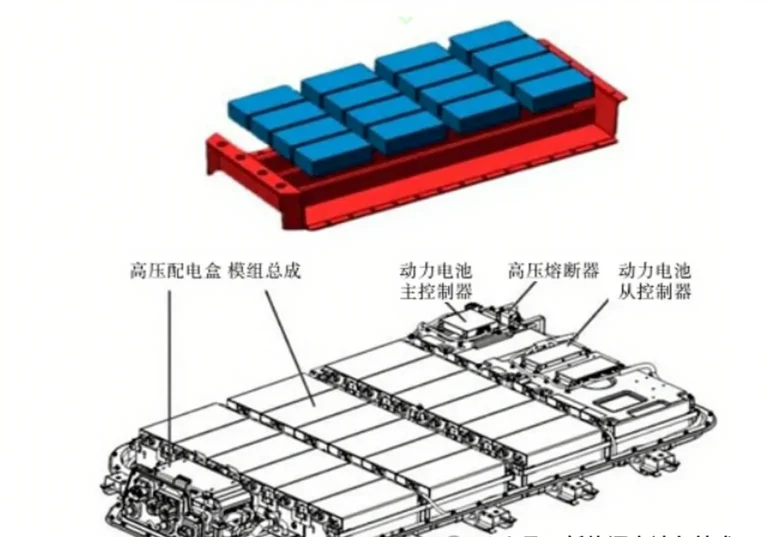
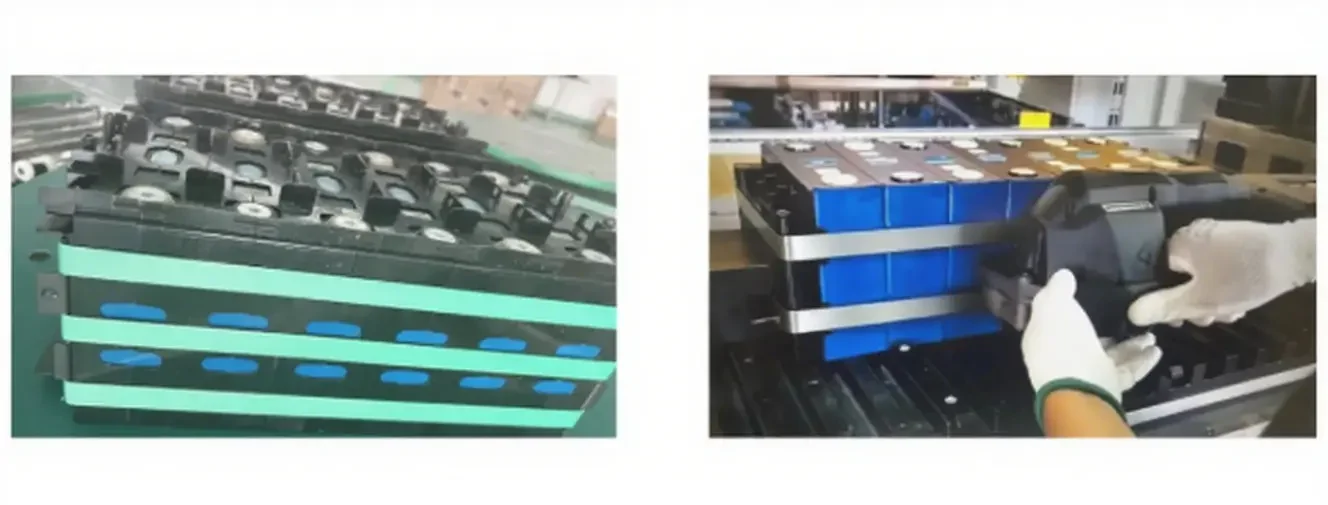
Semi-solid cells are usually prismatic or pouch, and they are sensitive to external stack pressure in a way conventional cells are not — the solid electrolyte layer needs 0.5–2 MPa of restraint to maintain contact through the expansion and contraction of a silicon-rich anode. Aircraft packs therefore include a compliant pressure frame or a spring-loaded module; that detail alone adds 4–8% to pack mass, which is part of why the system-level number lags the cell number. The thermal loop has to be liquid — a typical design runs a 50/50 water-ethylene-glycol loop at 2–4 L/min with cold plates bonded to the module faces, holding cells between 15 °C and 40 C in cruise. At altitude, ambient drops to −40 C at 1000 m and the pack needs a pre-heat capability before every flight, using the aircraft’s own bus power to bring cells to 20 C within 6 minutes, which is roughly 15 kW for a 200 kWh pack.
Discharge Profile for a City Hop
| Flight phase | Duration | Pack power | Energy per phase | Cell temperature rise |
|---|---|---|---|---|
| Hover / transition | 90 s | 420–520 kW | 1.6–2.3 kWh | +8–12 K |
| Cruise, 250 km/h | 12 min | 180–240 kW | 3.6–4.8 kWh | +4–6 K |
| Approach and descent | 3 min | 150–200 kW (regen 60 kW) | 0.6–1.0 kWh | +2 K with regen cooling |
| Ground / pre-flight | 8 min pre-heat | 15 kW | 2 kWh | −20 K to +20 K |
| Reserve, 20 km diversion | 8 min | 200 kW | 2.7 kWh | +5 K |
Vibration, Shock and Airframe Integration
An eVTOL pack is bolted to a structure that accelerates at up to 4 g in a hard manoeuvre and vibrates across a broad band from rotor passing frequency up to 2 kHz. Pouch cells need edge compression and a bond that carries shear, not just compression; prismatic cells need stiff end plates that do not fatigue at the cell tab weld. Vibration qualification for aviation battery modules is commonly run to RTCA DO-160 requirements, and shock to DO-160 Section 7.1, with random-vibration test runs of 60 minutes per axis at the installed mass and centre-of-gravity offset. Field-replaceable module design is now standard practice in the sector: rather than removing a 200 kWh pack, certified operators swap 20–40 kWh modules in the field, which changes how the battery is divided mechanically and electrically — each module gets its own contactor and its own isolation monitoring.
Certification Path and Documentation
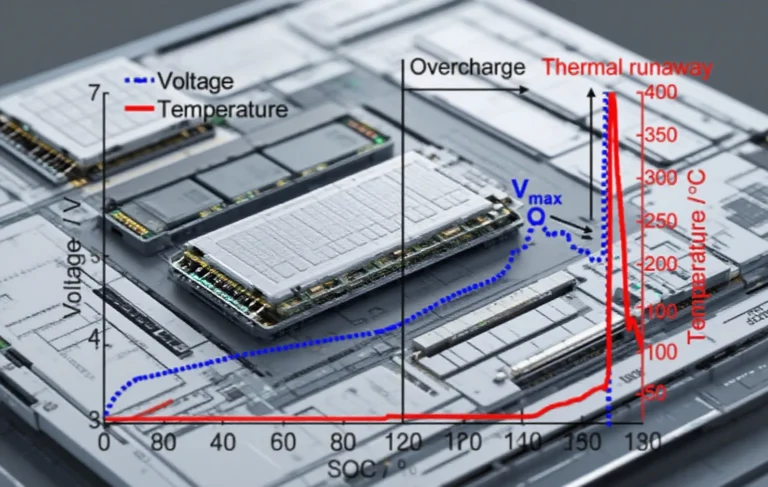
There is no shortcut to航空 certification. The aircraft, including its energy storage, is certified under an aviation-specific code, and the battery module must demonstrate that it will not emit hazardous levels of heat, smoke or toxic gas in any single failure condition. Practically that means: a fault tree with dual redundant cell-level protection, induction heating or fuse + pyrotechnic separation on every cell branch, a vent path designed for the worst-case internal short, and a fire suppression loop in the battery bay. Every cell must be traceable by serial number with its formation and test records retained, which is why semi-solid cell suppliers in the aviation chain are building serial-level data logs rather than batch averages. The long-term safety case is also being tracked internationally — the International Energy Agency publishes the transport electrification and storage analysis that policy and certification bodies reference when they look at where the technology is heading.
Specification Checklist for an eVTOL Pack
If you are evaluating a semi-solid pack for an airframe, demand these in writing: cell-level specific energy with the test temperature and C-rate; pack-level specific energy from a full system build, not a cell datasheet; discharge capability at −20 C and +50 C; the external stack pressure the cell requires and how the frame supplies it; cycle life at airframe duty with the capacity retention curve; the vibration and shock test report and the standard it was run to; thermal loop flow rate, inlet temperature and pressure drop; charge rate with the cold pre-heat budget; the failure-mode analysis with venting behaviour for the worst-case internal short; and the software interface state that the flight controller receives — typically per-module voltage, temperature, isolation resistance and a hard-fault flag, all at 10 Hz or faster. Any supplier who cannot produce the third item in that list is selling a laboratory sample, not a certified aircraft module.
People Also Ask
Is semi-solid-state battery certified for aircraft today? Not at commercial scale; several manufacturers are flying semi-solid packs on experimental and cargo platforms, but the first certified passenger eVTOL cells are expected only after a full airworthiness cycle, typically beyond the current aircraft design freeze.
How much range does a semi-solid pack add over conventional lithium? Around 15–30% more flight time at the same pack mass, because of the higher cell-level specific energy, assuming the pack’s thermal and structural mass does not grow as much as the extra energy requires.
Why can’t eVTOL just use LiFePO4? Because the energy density is roughly a third of what an aircraft needs; LiFePO4’s safety is excellent but 160–190 Wh/kg makes the weight budget impossible for a 20-minute reserve flight.
Written by Karl at China Battery Technology. Request a quote.