Lithium Battery for Mining Light Vehicles: Sizing and Safety Guidelines
Lithium Battery for Mining Light Vehicle: Sizing and Safety Guidelines
Underground operators are pulling diesel units out of drift, crosscut and service tunnels, and the vehicles that replace them — battery-electric light trucks, utility carts, service platforms and personnel carriers — run on traction packs. A working lithium battery manufacturer can deliver the discharge curves, enclosure rating and certifications that a mine site will actually accept, instead of a consumer pack that fails at the gate. This guide walks through how the pack is sized, what certification it must carry, and what the conversion costs over a five-year service life.
Why the Light-Vehicle Class Suits Lithium First
Light vehicles are the easiest entry point for underground electrification. They work on shallow, predictable duty cycles: a few accelerate-and-cruise cycles per shift, then a long idle while the operator drops materials or waits on dispatch. That pattern is close to ideal for lithium iron phosphate, which tolerates partial-state-of-charge cycling and does not suffer the sulfation damage that ruins a lead-acid bank after the third partial charge. Where a diesel 1.5-tonne service cart burns roughly 4–6 litres of diesel per hour and adds exhaust scrubbing, ventilation energy and particulate exposure, the same task on a lithium drive train produces no local emissions at all. Mines report the biggest win away from the engine: ventilation on demand instead of continuous dilution, which lets the primary fan run slower and cut kilowatt-hours across the whole shaft. Independent analysis from the U.S. Department of Energy on industrial storage cost curves makes the case for electrifying this vehicle class on economics rather than compliance alone.
Pack Voltage Platforms and Architecture
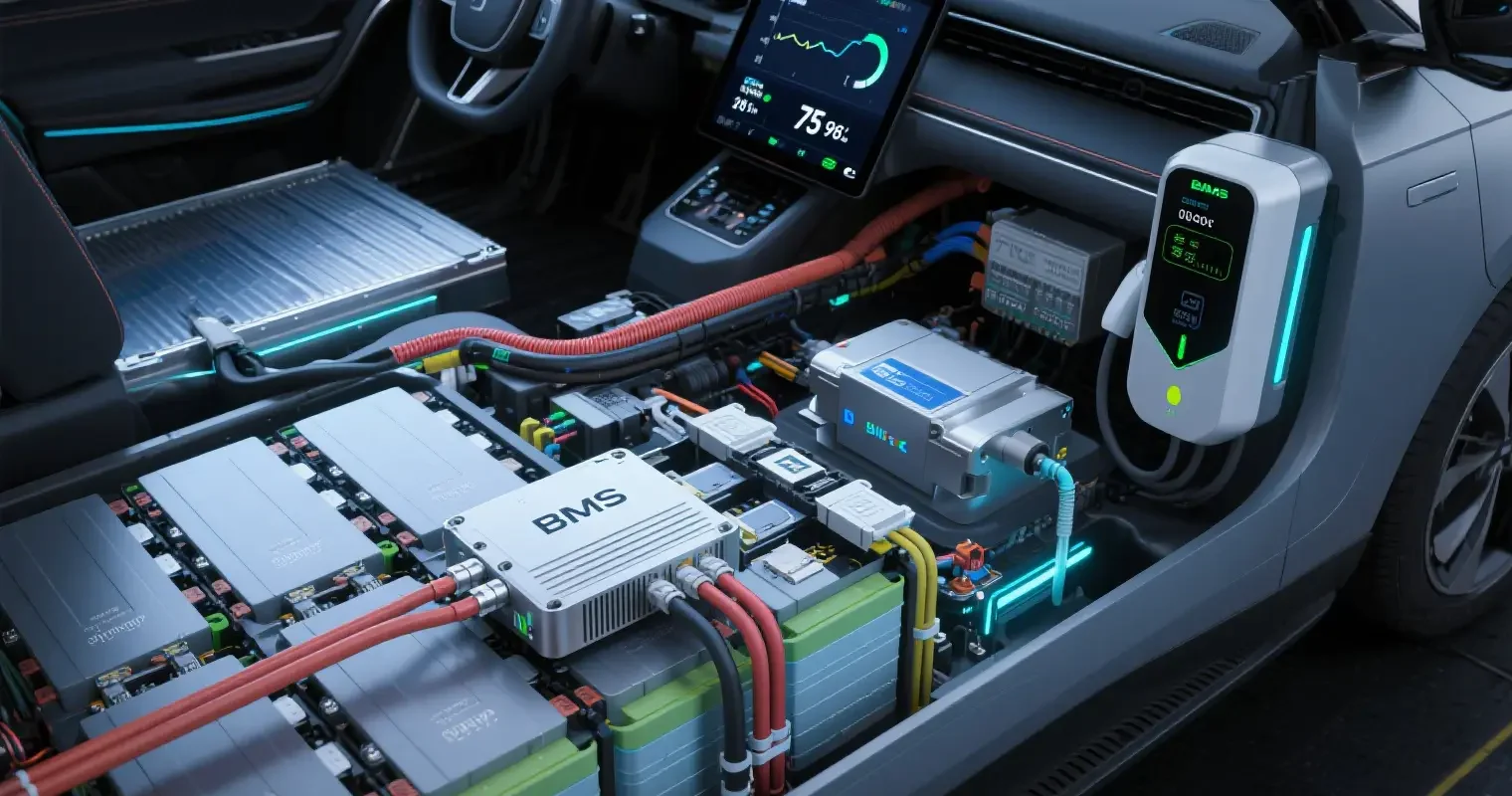
Most underground light vehicles were designed around a 48 V or 72 V DC traction bus, with some 80 V and 96 V systems in heavier units. A drop-in conversion keeps the existing motor and controller and replaces only the source: 16 series LiFePO4 cells give a nominal 51.2 V with a 40 V–58 V window, and 24 cells give 76.8 V nominal. Above roughly 2 C continuous the pack should use prismatic cells bolted to a rigid frame with busbars rather than Nickel-based cylindrical welds, because the vibration profile in a rugged tunnel environment works on every joint. The BMS needs at least a 500 A continuous rating with a peak of 3–5 C for hoist assist, cell-level temperature sensors on the big faces, and a contactor that opens on any single-sensor fault. Negative-temperature-coefficient thermistors should be bonded with thermal adhesive, not squeezed behind a plate, and the pack must be mountable on the vehicle’s original lift points so the frame stays crash-rated.
A Worked Sizing Example
Take a 1.2-tonne underground service cart on a 10-hour shift with a 40-minute travel leg each way. The traction motor draws an average of 3.5 kW climbing grades up to 8%, with peaks of 22 kW for start-up; auxiliary loads (lights, hydraulics for the dump body, a 500 W cab heater) add 600 W. Energy for traction is roughly 3.5 kW × 9 h = 31.5 kWh, auxiliaries 0.6 kW × 10 h = 6 kWh, so 37.5 kWh of delivered energy. Divide by the pack’s usable depth of 80% and a 0.9 inverter/motor efficiency and you land at a 52 kWh pack — in practice four 13 kWh modules in parallel. Size the continuous discharge for the average load but the peak for the motor’s 22 kW stall, so the BMS must support a 4C pulse for two seconds without striking the undervoltage floor. On that basis the pack weighs roughly 480 kg at about 160 Wh/kg at module level, against the 900 kg of lead-acid needed for the same usable energy, which is what puts the range at 45–55 km per charge instead of 18 km.
Certifications a Mine Site Will Demand
Any pack entering an underground working must carry a transport and safety file. UN 38.3 test summary is the baseline for shipping and is now required on every lithium shipment; the test criteria themselves are published by the United Nations transport of dangerous goods forum, and IEC 62619 covers stationary and industrial applications, with IEC 62933 applying where the pack is part of a storage system with an inverter interface. For the vehicle itself, look for packs tested to ISO 12405 for traction applications, and check that the design respects MSHA requirements for equipment in gassy or dusty atmospheres — in practice that means explosion-proof enclosures, spark-inhibited contacts and certified cabling rather than a generic IP-rated box. Ask the factory for the raw test report, not just a certificate image: the crush, impact and thermal-abuse sections should show pass conditions for the exact cell format you are buying. Reputable suppliers also publish a cell safety datasheet noting the thermal runaway propagation barrier, which is what prevents one bad cell from taking the module out.
Charging, Opportunity Charging and Fleet Handling
Lithium changes the charge pattern as much as the drive pattern. Because LiFePO4 accepts 0.5–1 C without stress, a cart that spends 20 minutes loading can recover 30–40% of its capacity, and many mines now run three opportunity charges per shift rather than one overnight charge. The charger should be a shared, cooled unit feeding a dc bus with each vehicle plugging in where it naturally stops. Track state-of-charge rather than hours: a fleet manager reading real pack data can spot a unit that always arrives at 25% and swap it before it strands a driver. Set a floor around 20% state of charge for the shift-end target so the pack never spends a shift below 10%, and calibrate the BMS current shunt once per quarter to keep the state-of-charge estimate honest across winter and summer.
Total Cost of Ownership Compared with Lead-Acid
| Attribute (10 000 km service life) | LiFePO4 Traction Pack | Lead-Acid Traction | Sealed AGM |
|---|---|---|---|
| Usable energy per charge | ~90% of nameplate | 50% of nameplate | 40% of nameplate |
| Cycle life to 80% capacity | 3000–6000 deep cycles | 1200–1800 cycles | 400–800 cycles |
| Pack mass for 40 kWh | ~310 kg | ~720 kg | ~780 kg |
| Charging window | 20–40 min opportunity | 6–8 h | 8–10 h |
| Ventilation demand added | None | High (dilution of exhaust) | None |
| 10-year cost per km | Lowest | Highest | Middle |
People Also Ask
Can a lithium pack be dropped into an existing diesel-cart chassis? Usually yes for 48 V and 72 V platforms, provided the motor controller accepts the pack’s voltage window and the vehicle’s frame can carry the lower mass. Confirm the controller’s minimum voltage and add a dc/dc converter for the 12 V cabin circuit.
How hot can an underground pack get before it is a problem? Runtime above 45 °C on the cell face is the usual derating line; specify thermostat-controlled charging above 40 °C and keep the pack out of direct heater blast on the drivetrain side of a vehicle.
What is the realistic payback on a conversion? On a light vehicle working three shifts a day, diesels costs and ventilation savings typically repay a lithium conversion in 18–30 months, and the pack is good for a second vehicle after the first.
Written by Karl at China Battery Technology. Request a quote.