Home Energy Storage for Duplex: One Battery, Two Households
A duplex presents an energy storage problem that a single-family house does not: two households, one shared roof and usually one service connection. Splitting a battery between them can be the most economical route to backup power and solar self-consumption, but only if the system is designed around how the two units actually consume energy and how the costs and benefits get divided. A well-specified home energy storage system will handle this with clear metering, sensible backup priorities and an agreement between the owners that survives the first winter bill.
Three Ways to Configure a Duplex
There is no single correct answer — the right choice depends on ownership, metering and how much the two households trust each other’s load behaviour.
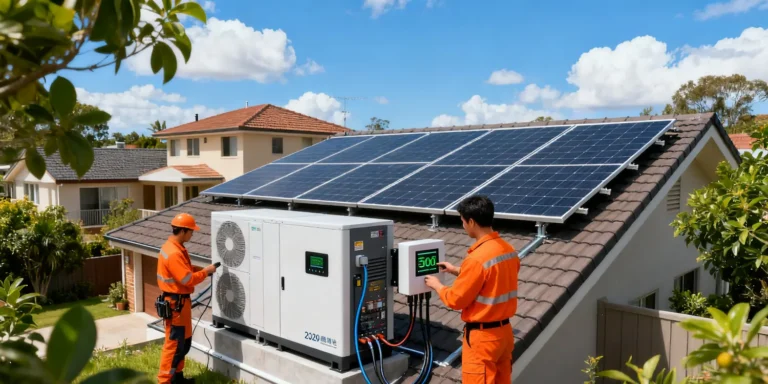
- One shared system: a single battery and inverter behind the common service. Lowest cost per kilowatt-hour and best overall self-consumption, because the two units’ load profiles complement each other.
- Two independent systems: each unit has its own battery. Highest cost, but complete autonomy, no sharing disputes, and each owner can size to their own needs.
- Shared battery, split inverter: one battery bank with separate monitored outputs to each unit’s distribution board. A middle path that keeps fair accounting while sharing the expensive asset.
Why Shared Storage Often Wins on Economics
Two households rarely use power at the same time. One unit is empty during the day while the other runs a home office; evening peaks differ by an hour or two. A shared battery sees a combined load curve that is flatter and better matched to solar production, so a given kilowatt-hour of storage delivers more usable energy across the two units than the same capacity split in half. In practice a shared bank can be 20–30% smaller than two separate systems for equivalent performance.
Duplex Storage Configuration Comparison
| Attribute | Shared System | Two Independent Systems | Shared Battery / Split Output |
|---|---|---|---|
| Capex per kWh usable | Lowest | Highest | Medium |
| Self-consumption efficiency | Best | Good | Best |
| Billing clarity | Needs sub-metering | Inherent | Clear per unit |
| Backup flexibility | Single priority list | Separate per unit | Separate per unit |
| Expansion path | Add capacity centrally | Each owner decides | Add capacity centrally |
| Dispute risk | Highest without agreement | None | Low |
Metering and Fair Allocation
Fair allocation is the whole problem. The practical solution is a revenue-grade sub-meter on each unit’s feeder, logging import, export and battery discharge separately. With that data, an allocation rule can be applied: proportional to consumption, proportional to battery usage, or a fixed split with an annual true-up. Whichever the owners choose, it should be written down before installation, because retrofitting metering after the fact is far more disruptive than fitting it during the build.
Sizing from Combined Load Data
Pull twelve months of interval data for both units separately, then combine them into a single 15-minute or hourly profile. From that combined curve, size storage against the evening peak — the hours between sunset and bedtime when solar is gone and both units are drawing. Most duplexes land between 10 and 20 kWh of usable capacity. Use the same curve to check whether the inverter’s continuous rating covers the rare simultaneous peak when both units run air conditioning or an EV charger at once.
Backup Priorities When Two Families Are Affected
In an outage, the shared system must decide what gets power. The usual approach is to back up both units’ essential circuits — lighting, refrigeration, communications, a small heating or cooling load — rather than whole-house backup for either household. This keeps the battery from being drained by one unit’s tumble dryer while the other sits in the dark. Define the essential circuit list during design, and label the sub-boards clearly so everyone knows what will and will not run.
What to Specify With Your Installer
Ask for: usable (not nominal) capacity in kWh, continuous and surge inverter power, round-trip efficiency, a warranty that states retained capacity at year 10, per-unit sub-metering with data export, and a written backup circuit schedule. Confirm the battery location meets fire separation requirements for attached dwellings, and check that the installer has done multi-unit residential work before.
Getting Started
Collect both units’ twelve-month load data and any solar production figures, sketch the existing service and sub-board layout, and agree the allocation rule in writing. With those three things a storage supplier can size the system accurately and quote a duplex installation that both households will be happy with.
People Also Ask
Can one battery legally serve two units? In most jurisdictions yes, provided the installation meets electrical code for shared systems and each unit’s supply is properly protected and metered. Always confirm with the local authority having jurisdiction before ordering equipment.
What happens if one household uses far more power? That is what sub-metering solves. Energy taken from the battery is attributed to the unit that drew it, so the allocation reflects actual use rather than an assumed split.
Is a shared battery a problem when one unit is sold? It can be, which is why the arrangement should be formalised in the ownership documents. Alternatively, design the system so it can be separated later without major rewiring.
How much capacity does a typical duplex need? Most fall between 10 and 20 kWh usable, sized against the combined evening peak rather than the daytime load. Twelve months of interval data will give a reliable answer.
Written by Karl at China Battery Technology. Request a quote.
Related Reading
- home energy storage system guide
- Home Energy Storage for Townhouse: Backup Power on a Shared Wall
- Home Energy Storage for a Home Sauna: Sizing and Costs