Sodium-Ion Battery for Oil Field Pump Jack: Off-Grid Power That Survives Winter
Sodium-Ion Battery for Oil Field Pump Jack: Off-Grid Power That Survives Winter
Stripper wells and marginal leases sit at the end of long, expensive distribution lines, and running new three-phase service to a single beam pump often costs more than the well earns in a decade. Operators have answered with diesel gensets, solar arrays and lead-acid banks, all of which struggle in a Permian summer or an Alberta winter. A sodium ion battery changes the calculation for these sites because it keeps usable capacity at temperatures where lithium iron phosphate must be heated before it will accept a charge, and it does so without cobalt, nickel or lithium in the bill of materials.
The Load Profile Nobody Designs For
A beam pump is a regenerative load, not a steady one. On the upstroke the motor lifts the rod string and draws heavily; on the downstroke gravity drives the rods and the motor can act as a generator, pushing current back toward the source. A typical 25 to 40 horsepower pumping unit therefore presents a sawtooth pattern repeating every four to eight seconds, all day, every day. Counterbalance tuning reduces the swing but never removes it. Storage on a wellsite consequently sees millions of shallow micro-cycles rather than one deep cycle per day, and shallow cycling is where sodium chemistry is most comfortable.
Why Cold Weather Decides the Chemistry
Hard carbon anodes used in sodium cells do not suffer the same plating risk that forces lithium packs to warm up before charging. Field data and supplier testing consistently show sodium cells retaining 85 to 90 percent of rated capacity at minus 20 degrees Celsius, against 60 to 70 percent for LiFePO4 without heating. On a solar-charged wellsite in January that difference is decisive: a lithium system spends part of a short winter day heating itself with energy it needs for the pump, while the sodium system simply charges. Removing the heater also removes a relay, a controller channel and a failure mode from an unmanned site.
Wellsite Storage Options Compared
| Attribute | Sodium-Ion | LiFePO4 | AGM Lead-Acid | Diesel Genset |
|---|---|---|---|---|
| Capacity at −20 °C | 85–90% | 60–70% (needs heater) | 50–60% | Hard starting |
| Cycle life | 3000–5000 | 3000–6000 | 400–800 | n/a |
| Site visits per year | 1–2 | 1–2 | 4–6 | 12–24 (fuel, oil) |
| Fuel or heating parasitics | None | Heater load | None | Continuous fuel |
| Thermal runaway risk | Very low | Low | Low | Fire and fuel spill |
| Raw material exposure | Sodium, iron | Lithium | Lead | Diesel price |
Sizing a Pump Jack System
Start with the pumping unit nameplate and its duty cycle. A 30 horsepower unit running a 60 percent timer draws roughly 13 to 15 kW average, or around 320 kWh per day. Few operators try to run that entirely from storage. The common architecture is a solar array sized to the daily energy plus 25 percent, a battery sized for one night plus one cloudy day, and a small generator retained as a rarely used backup. That usually lands between 150 and 250 kWh of storage per well. Sites running only SCADA, a chemical injection pump and a plunger lift controller need far less, often 10 to 20 kWh, and those are the easiest projects to justify.
Handling the Regenerative Downstroke
The energy returned on each downstroke must go somewhere. Without storage it is burned in a braking resistor, which is pure waste and a heat source in a classified area. With a battery on the DC bus the inverter can recover a meaningful share of it, typically 8 to 15 percent of gross consumption depending on counterbalance condition. That recovered energy is effectively free and it shortens the payback of the whole installation. Specify a bidirectional inverter rated for the regeneration peak, not just the motoring load, or the system will fault on the first well with a badly balanced beam.
Classified Areas and Practical Installation
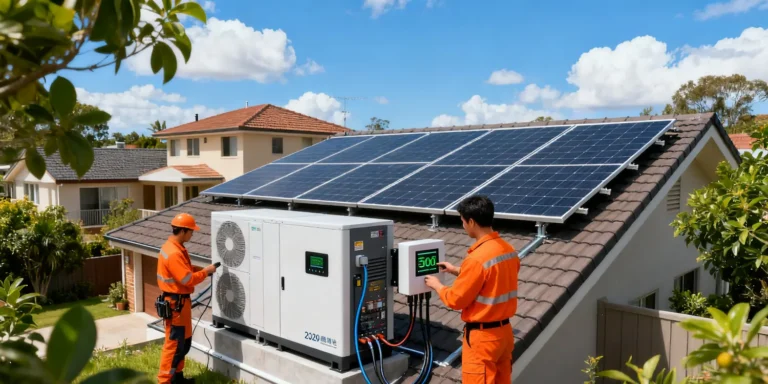
Battery enclosures normally sit outside the classified radius around the wellhead, on a skid with the inverter and controls. Keep cable runs short to limit voltage drop at high current, use enclosures rated for blowing dust and driven rain, and specify a management system that reports over the existing SCADA radio rather than requiring its own link. Remote state-of-charge visibility is what turns a battery from a maintenance item into an asset, because a pumper can see a failing site from the truck instead of discovering it on a scheduled round.
People Also Ask
Can sodium batteries fully replace a wellsite generator? On light-load sites running instrumentation and injection pumps, yes. On full pumping units most operators keep a small generator for extended low-sun periods, but annual runtime typically drops by 80 percent or more.
How does sodium-ion cost compare on a wellsite? Cell cost per kilowatt-hour is currently near LiFePO4 and falling as volume grows. The savings appear in the balance of system: no heating, fewer service visits and no fuel logistics on remote leases.
What lifetime should I plan for? Eight to twelve years is a realistic planning horizon for shallow-cycling wellsite duty, well beyond the economic life of many marginal wells.
Is the extra weight a problem? Sodium packs are heavier per kilowatt-hour than lithium, but a skid-mounted stationary system does not care. Weight only matters if the enclosure must be lifted frequently between locations.
Written by Karl at China Battery Technology. Request a quote.
Related reading: Sodium-Ion Battery for Offshore Platforms: Safer Remote Power