Semi-Solid-State Battery for Industrial Robotics: Safer, Denser Autonomy
Semi-Solid-State Battery for Industrial Robotics: Safer, Denser Autonomy
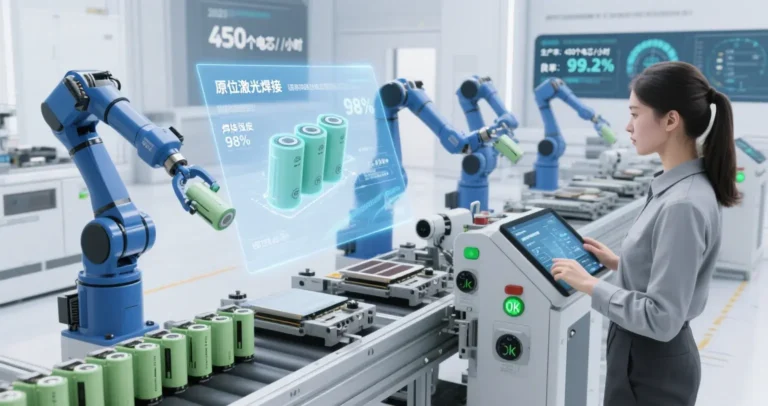
Automated guided vehicles, autonomous mobile robots, and six-axis arms increasingly define factory throughput, and their battery is the bottleneck on shift length and footprint. A semi solid state battery — one that keeps a little liquid electrolyte but replaces most of it with a solid or gel composite — lets integrators pack more watt-hours into the same battery bay while lowering fire risk on a crowded line. That combination is why robotics buyers are watching semi-solid move from pilot to production.
Why Robotics Pushes Cell Limits
A mobile robot pays rent on every cubic centimeter of battery bay, and an arm pays on every gram at the wrist. Higher energy density means longer shifts between charges or a smaller pack for the same runtime — both raise utilization. Robotics also cycles hard and fast, so the cell must take high charge rates during opportunity top-ups without premature aging.
Semi-Solid vs Liquid Li-ion vs Full Solid-State
| Attribute | Li-ion (liquid) | Semi-solid-state | Full solid-state |
|---|---|---|---|
| Energy density | 180–260 Wh/kg | 300–360 Wh/kg | 400+ Wh/kg (target) |
| Fast-charge tolerance | Good | Good–Excellent | Excellent (target) |
| Thermal safety | Moderate | Improved | Best |
| Line compatibility | Mature | Mostly existing | New equipment |
| Cost today | Lowest | Mid | Highest |
Sizing Robot Packs
Size to a full shift plus a safety margin, then confirm the charger can opportunity-top-up during breaks so a single pack covers multiple shifts. For wrist-mounted or arm-embedded packs, weight is the design driver; for AGVs, volume and fast-charge rate usually matter more than absolute density. Model the real duty cycle — including acceleration spikes — rather than quoting nameplate capacity.
Safety on the Factory Floor
Reduced free electrolyte lowers the chance of a line-stopping thermal event, and the softer cell tolerates vibration from constant motion. Specify the BMS with CAN/RS485 reporting, redundant contactors, and cell-level fusing so a fleet manager sees state-of-health before a pack degrades mid-shift. In a busy plant, predictable aging beats a few percent of extra range.
Integration Checklist
Confirm the mechanical envelope, the connector type, and the communication protocol before committing. Semi-solid packs often reuse existing lithium form factors, which shortens integration, but the charger profile can differ — verify the constant-current and constant-voltage setpoints with the supplier. Pilot one cell line first, then standardize the fleet on the batch that passes your cycle-life target.
Common Failure Modes
Early issues tend to be interface resistance growth at the solid-electrolyte boundary and batch-to-batch inconsistency from a still-scaling supply chain. Mitigate with conservative operating windows during the first thousand cycles and supplier batch traceability. These are manageable today and improving fast through 2026.
Choosing the Right Supplier
Work with a manufacturer that can qualify cells to your duty cycle, supply the mating fast charger, and document cycle life at your depth of discharge. For semi-solid, confirm the electrolyte fraction and the supplier’s production volume — capacity is scaling quickly through 2025–2026, but batch consistency still varies by vendor.
Cost and Payback
Semi-solid carries a price premium over liquid Li-ion today, but the payback on a robot fleet comes from fewer pack swaps, longer runtime per shift, and lower insurance and enclosure cost from the improved safety margin. Model it as total cost per operating hour, not pack price, and the denser cell usually wins once a line runs multiple shifts.
People Also Ask
Are semi-solid cells available for robots now? Yes — several suppliers ship semi-solid packs for premium AGV and robotics pilots, with broader volume arriving through 2026.
When will full solid-state replace them? High-volume robotics-grade solid-state is still scaling; semi-solid is the practical density-and-safety step available today.
Do semi-solid packs need a special charger? Often the same physical connector as lithium, but confirm the CV/CC profile with the supplier — early sets can differ from liquid Li-ion.
Written by Karl at China Battery Technology. Request a quote.