Semi Solid State Battery for Firefighting Drone: Longer Sorties, Safer Payloads
Semi Solid State Battery for Firefighting Drone: Longer Sorties, Safer Payloads
Fire services now fly drones for thermal mapping, hot-spot spotting, and even hose or extinguisher-ball delivery over structures no crew should enter. Those aircraft carry heavy payloads through rising thermal columns, and their batteries are the limiting factor on every sortie. A semi solid state battery raises usable energy per kilogram while keeping the electrolyte partly immobilised, which is exactly the trade a fire-ground operator wants: more minutes in the air, and less chance the pack itself becomes the emergency.
Why Firefighting Drones Punish Batteries
A survey drone sips power. A firefighting drone does not. Lifting a thermal camera, a gas sensor, a spotlight, and sometimes a water or powder payload means near-continuous high current, often at 8–15C bursts when the aircraft fights turbulence over a burning roof. Add ambient air that may sit 20 C above normal and the pack is being drained hard while it is already hot. Standard lithium-polymer packs sag under that combination and land with barely usable capacity.
What Semi-Solid Changes
Semi-solid cells use a thickened gel or paste electrolyte instead of a free-flowing liquid. That lets the cell run higher-capacity anode chemistries without the internal shorting risk of a pure liquid design, and it means a punctured or crushed cell does not spill and wick electrolyte across neighbouring cells. Practically, an operator sees 20–40% more energy for the same pack weight, which converts directly into extra loiter time over the incident.
Thermal Behaviour Near the Fire Ground
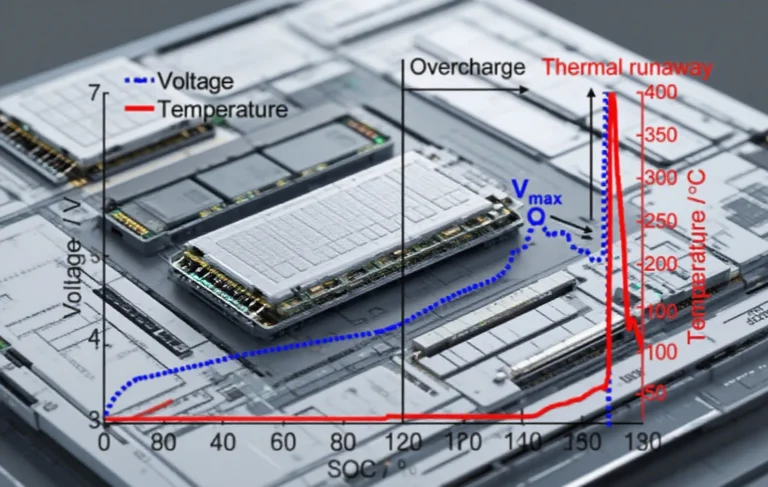
The real argument for semi-solid on a fire drone is not range, it is margin. Immobilised electrolyte raises the temperature at which a damaged cell goes into runaway, and it slows propagation from one cell to the next. A drone that lands hot, gets rinsed with water, or takes a debris strike is far more likely to be recoverable. Crews can also stage spare packs closer to the operation without treating them as a separate hazard.
Firefighting Drone Battery Comparison
| Attribute | Semi-Solid | Li-Po | LiFePO4 |
|---|---|---|---|
| Energy density | High | High | Low |
| High-temp tolerance | Good | Poor | Good |
| Puncture behaviour | No free spill | Spills, wicks | Spills |
| Burst current | High | Very high | Medium |
| Cost per pack | Higher | Low | Medium |
Payload and Flight Time Maths
Flight time on a multirotor scales roughly with energy divided by total mass, so the gain is not linear. On a 25 kg-class platform, swapping a 1.5 kWh liquid pack for a semi-solid pack of the same weight typically buys four to seven extra minutes of loiter, or lets the crew carry another two kilograms of payload for the same endurance. Fire officers usually spend it on payload — a better thermal sensor or a heavier delivery load matters more than an extra lap.
Charging Between Sorties
Incidents run in cycles, so turnaround discipline drives fleet size. Let packs cool to near ambient before charging, then charge at the manufacturer’s rated rate rather than the fastest setting the charger offers. Run a rotation of at least three packs per airframe so no cell is ever charged straight off a hot landing. Log cycles per pack and retire on cycle count, not on appearance.
Field Handling and Transport
Store packs at roughly 50% state of charge in a vented metal case in the appliance, not loose in a kit bag with tools. Inspect for swelling, casing deformation, and connector heat marks after every incident, and quarantine anything suspect in a fire-safe container. Semi-solid packs still fall under dangerous-goods rules for air freight, so confirm the cell certification and watt-hour rating with your supplier before shipping spares to a deployment.
Specifying a Pack
Give the manufacturer the airframe’s peak and continuous current, the connector standard already in your fleet, the operating temperature band you expect on a summer fire ground, and any BMS telemetry your ground station reads. Ask for cycle-life data at your actual discharge rate rather than a laboratory 1C figure — the gap between the two is where fleets get surprised.
People Also Ask
Is a semi-solid pack safe if the drone crashes into a fire? Safer, not immune. Immobilised electrolyte raises the runaway threshold and slows cell-to-cell propagation, but a badly damaged pack still needs to be treated as a hazard and cooled from a distance.
Can I retrofit semi-solid packs to my existing drone? Usually yes, if the voltage, connector, and physical envelope match and the BMS talks to your flight controller. Confirm the continuous current rating covers your worst-case payload before the first flight.
How much extra flight time should I expect? Plan on 15–30% more endurance at equal pack weight, and treat anything above that as a bonus rather than a mission assumption.
Written by Karl at China Battery Technology. Request a quote.
Related reading: Semi-Solid State Battery for VR Headsets: Lighter, Safer Immersion