Lithium Battery for Aerial Survey Drone: Flight-Time Engineering
Lithium Battery for Aerial Survey Drone: Flight-Time Engineering
A survey mission is a battery planning problem wearing a geography costume. The flight manager knows the area, the ground sample distance and the overlap requirement; somewhere underneath that plan is a pack that has to deliver 25–40 minutes of hover plus reserve, survive a hot charge in a field tent, and not swell when it comes off the aircraft after a summer afternoon. A specialist lithium battery manufacturer supplies high-discharge UAV packs with the traceability, discharge curves and cycle data that a mapping contractor needs to quote a job confidently. This article covers the maths, the charge discipline, thermal and cold behaviour, transport compliance and how to size a pack for a survey instead of guessing.
The Flight Profile That Drives the Pack
A multirotor survey flight is not a steady load. Takeoff consumes 2–3 times cruise current for 20–30 seconds, cruise draws a near constant 40–60% of the pack’s continuous rating at a survey altitude of 60–120 m, and the manoeuvre at the end of each grid line spikes the current again while the airframe fights its own wake. If you size from average current you will land short. The correct method is: estimate the true airspeed, compute the induced power needed at that speed, convert to pack current with the ESC efficiency (typically 92–95%), add takeoff and turn surges, then hold back 20–25% of the result as reserve so the aircraft returns with enough energy to fly another approach at the far corner of the survey area. Most operators lose a flight to taking off with 8% remaining and discovering the wind is stronger than the forecast.
Pack Format and Cell Selection
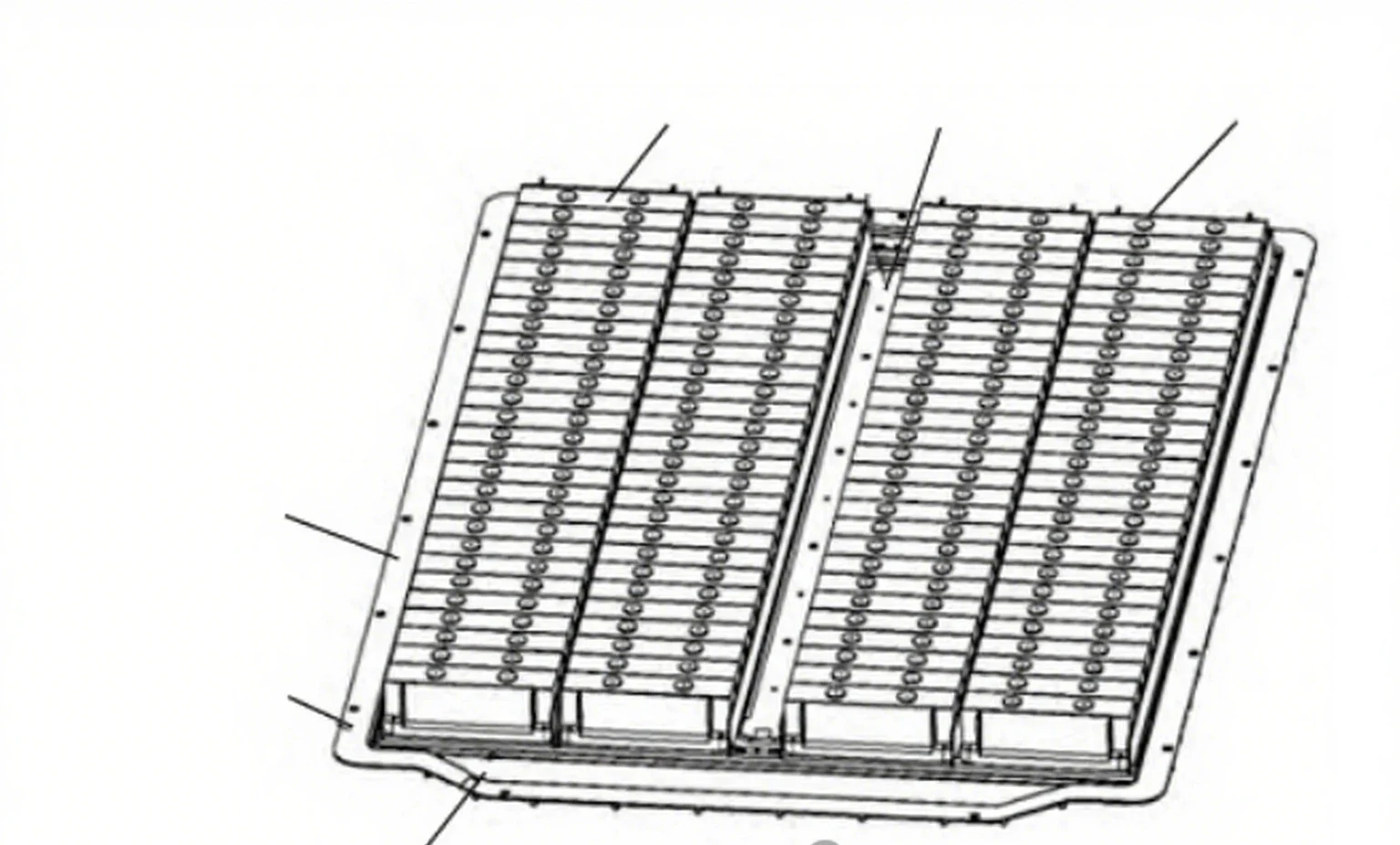
Two formats dominate: the 6S–12S rectangular “square” pack that bolts into the airframe bay, and the 4S–6S cylindrical 21700 arrangement used by smaller mapping drones. Square packs are assembled from 18650 or 21700 cells in a 4s4p or 6s4p arrangement and abandoned after 200–500 charge cycles, which is cheaper per flight than swapping individual cells. Cylindrical packs built from 21700 cells with a sustained 15C rating deliver longer life and better thermal behaviour because the cell’s recommended discharge limit is 20C for short pulses. Whichever you choose, look for the pack’s internal resistance: a healthy 6S 22000 mAh survey pack sits around 25–35 mΩ, and anything above 60 mΩ after 200 cycles means you are on borrowed capacity. Also specify a discharge curve sheet at 25 A, 0.5C and at 5C — the two curves differ by 15–25% in delivered capacity, and contractors who only see the 0.5C number over-promise the customer.
Charge Cycle Discipline Between Flights
A survey day is a charge-cycle puzzle. Charging six packs sequentially from a 1000 W charger into 22000 mAh 22.2 V packs means roughly 36 minutes per pack if you charge in parallel, which is why field crews buy a 4–6 port smart charger and cycle packs in rotation. The rules that extend life: never charge a hot pack — let it fall below 40 C first, and charging above 45 C cell temperature costs roughly 40% of cycle life; do not leave a pack at storage voltage overnight at 100% before a morning flight if you can charge in the truck immediately before launch; and balance every third or fourth charge so the pack’s cells stay within 30 mV of each other, otherwise the BMS will cut the pack early on the flight where you needed the full minute. Cap the charge at 4.2 V per cell for LiCoO2 chemistry or 3.65 V for LiFePO4, and do not accept a charger that does not report per-cell voltage.
Cold Weather and Hot Tents
Survey work runs in both directions on the temperature scale, and lithium behaves differently at each end. At 0 C a LiCoO2 UAV pack loses 10–20% of cold cranking capability and the internal resistance roughly doubles, so a pack that flies 32 minutes at 20 C may give 24 minutes at −5 C; the fix is a baffled insulation sleeve plus a warming pack before takeoff, held between 15 C and 25 C. At the other end, a pack that has just been charged in a 35 C field tent and flown immediately can cook: continuous discharge above 60 C cell temperature is where separator breakdown starts, and the marginal gain in flight time from flying sooner is smaller than the life you lose. A good operational rule for desert survey work is to charge, let the pack sit for 20 minutes, then fly — and to log cell temperature after every flight so the season’s data shows the real degradation curve.
Capacity Comparison for Common Survey Platforms
| Platform class | Bus voltage | Usable pack | Typical survey flight | Reserve target |
|---|---|---|---|---|
| Quad, 250 mm mapping | 6S (22.2 V) | 11 Ah | 14–18 min | 20% |
| Quad, 450 mm survey | 6S (22.2 V) | 22 Ah | 25–32 min | 22% |
| Hex, 680 mm RTK | 12S (44.4 V) | 22 Ah | 28–38 min | 25% |
| VTOL fixed-wing survey | 6S or 14S | 30–40 Ah | 45–70 min | 15% |
| Heavy-lift hex, 25 kg class | 12S (44.4 V) | 60 Ah | 30–40 min at 8 kg payload | 25% |
Transport, Compliance and Airworthiness
Survey contractors move packs by road, air and occasionally by ship, and the paperwork is not optional. UN38.3 test summaries and the shipping classification for lithium cells are published by the United Nations Economic Commission for Europe, which maintains the model regulations that air and ground carriers implement; a survey operator carrying more than nine spare packs in a checked bag is already in regulated territory. On the airworthiness side, a damaged or swollen pack must come off the aircraft — a swollen cell in a bay that is bolted shut is a fire risk you cannot monitor mid-flight. Commercial operators flying Part 107 or equivalent also log pack serial numbers against flight hours, partly for maintenance and partly so an incident investigation can trace the cells. The wider electrification and drone logistics context is tracked by the International Energy Agency, whose energy-system analysis is the reference most civil-aviation regulators cross-check against.
Sizing Worked Example
Work a real case: 900 hectares, fixed-wing VTOL, 8 km/h survey speed, 120 m AGL, 2 cm ground sample distance, 12 minutes per battery line of 1.4 km. Your aircraft draws 38 A from a 22.2 V bus in cruise and 95 A on takeoff. Cruise energy per hectare comes to about 0.42 Wh, so 900 hectares needs roughly 378 Wh of flight energy; add 25% manoeuvre margin and 20% reserve, and you need about 567 Wh delivered from the pack, which is a 22 Ah 6S pack at 25.7 V usable. Add 15% for a headwind day and the answer is 25 Ah. That single calculation is the difference between a crew that finishes the 900 hectares in a day and one that drives back at noon to swap four packs — and it is the calculation worth writing into every survey quotation.
People Also Ask
How many cycles does a survey drone battery give? A good high-discharge pack delivers 300–600 charge cycles keeping capacity above 80%, and many operators replace on schedule at 400 cycles rather than waiting for a visible failure.
Should I fly to empty to maximise usable capacity? No. Landing at 20% protects the pack from deep-cycling stress and leaves you the reserve to route around a wind change; flying to 5% gains two minutes and costs cell life.
Is it safe to charge drones indoors overnight? Only in a fire-resistant container with a working charger cutoff and nocombustibles nearby; slow charging overnight is acceptable but the pack must be inspected before it goes back on the aircraft.
Written by Karl at China Battery Technology. Request a quote.