Lithium Battery for Skid Steer Loaders: Specifying a Compact Electric Machine
Lithium Battery for Skid Steer Loaders: Specifying a Compact Electric Machine
A skid steer loader is the harshest compact duty a battery pack can see outside a tunnel. The machine lifts 700 to 1,900 kilograms of aggregate eighteen times an hour, shoulders it up to three metres, dumps it, and drives back down a muddy slope for the next bucket. Each pass is a high-rate discharge, a hard braking event and a structural shock load stacked together. A pack designed for a pickup truck will not survive this service unmodified. What works is a purpose-built lithium battery manufacturer package engineered around the hydrostatic drive, the boom regeneration and the salt-and-dust reality of a worksite. This guide walks the voltage platform, cell format, thermal packaging, certification path and the payback arithmetic that decides whether a fleet conversion makes sense at all.
Why a Compact Machine Beats a Pickup on Pack Stress
The small machine is harder on cells than the big one, which surprises most buyers. A full-size electric tractor fits forty cells in series behind a three to six kilowatt continuous traction load, so every cell idles. A skid steer pushes forty-five to seventy kilowatts through a piston pump while the operator crowd the joystick, which means the pack delivers four to six times its rated current in bursts from a volume smaller than a wine fridge. Heat has nowhere to escape because the enclosure sits inside a forty-five degree bay during summer works. Add the shock: a bucket dropped from two metres lands on the frame at eight to twelve g, and that propagates straight into every busbar and weld. Cells that shrug off a golf cart will crack a tab and delaminate a BMS sense board within one season here.
Voltage Platforms: 48 V, 80 V and Where 96 V Is Headed
Almost every conversion lands on one of three platforms. Older sixty-volt machines are still common and aftermarket kits often push them to seventy-two volts. The modern baseline is forty-eight volts for machines under one thousand kilograms and eighty volts for the twelve-hundred to nineteen-hundred kilogram class, with ninety-six volts gaining ground because it halves the copper in the traction run. Voltage matters for two concrete reasons. A higher platform current means less resistive loss in the cable and less heat trapped inside the pack, and a higher nominal pack voltage lets the balancing circuit work at a lower current. Sixteen 3.2 volt prismatic cells give a 51.2 volt nominal forty-eight volt pack; twenty-five cells give an eighty volt nominal pack. Matching the motor controller exactly keeps the pack three to five percent cooler, and that margin is what buys cycle life.
Cell Format: Prismatic LFP Versus Pouch for Frame Mounting
For bolting into a machine frame, prismatic lithium iron phosphate is the safer default. A fifty amp-hour prismatic cell measures roughly 148 by 91 by 173 millimetres and terminates in a copper tab good for two hundred amps continuous, so the pack builder can clamp cells straight onto a busbar plate instead of relying on nickel strip spot welds. Pouch cells carry more energy into the same envelope and run cooler per cycle, but they demand a rigid housing to stop the stack swelling against its own end plate, and in a skid steer the pack is bolted to the rear frame member, so that housing has to be the case. Pouch also carries a higher single-cell short risk if the case is dented by a stray bucket tooth. The specification that holds up in this industry is grade-A prismatic LFP rated for 3,000 cycles at half rate and 25 degrees, which realistically becomes 4,500 cycles once the pack is cycled at 3C every shift.
Thermal and Mechanical Packaging Inside the Footprint
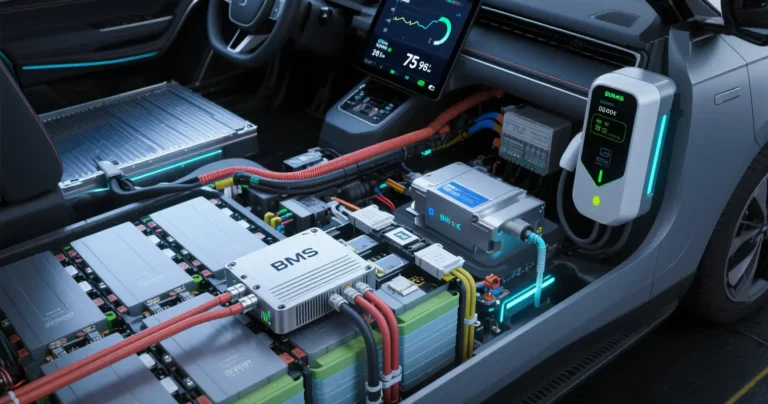
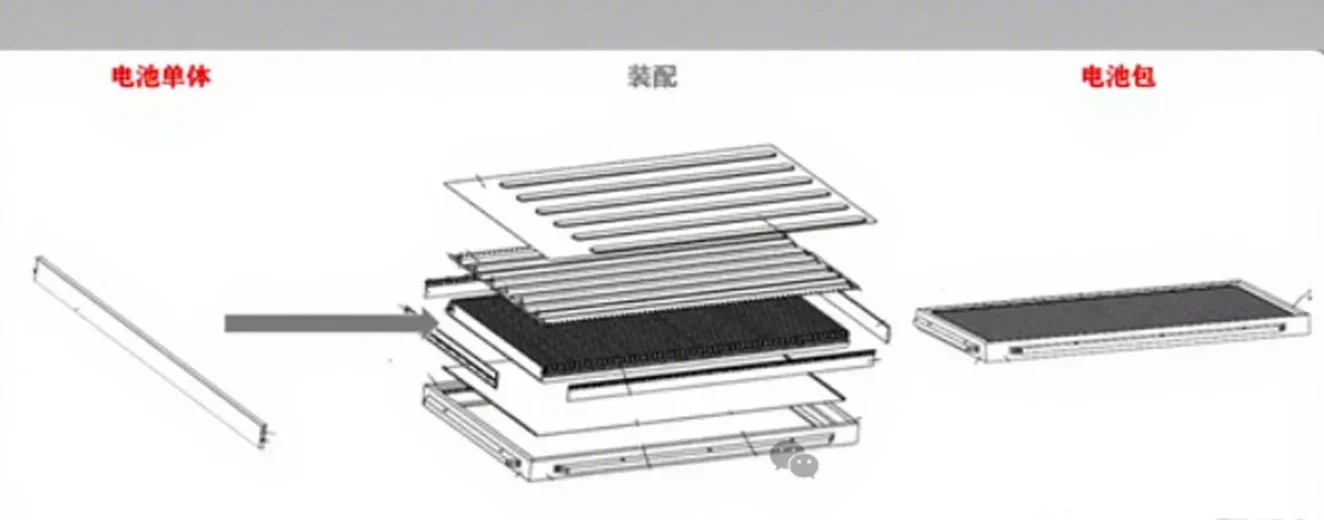
Packaging is where most conversions fail their first inspection. The pack is normally a welded steel or aluminium enclosure at IP65, bolted to the rear chassis, gasketed lid, vented to outside air. Inside, the cells sit on a glass-fibre tray with elastomer mounts at each corner so no bump reaches a cell tab directly. The BMS should hang off a shielded four-wire CAN trunk with individual slow-blow fusing ahead of the pack output stud, and the main contactor must be a sealed high-current device rated for the pump motor inrush rather than a cheap automotive relay. Cooling is normally passive finning plus a duct taken from the machine’s radiator fan, because fitting a compressor costs efficiency. The target is a forty degree Celsius maximum cell temperature at fifty kilowatts continuous, which is a reachable but not generous number on a closed rear frame.
Regenerative Braking and Duty-Cycle Sizing
Size the pack from the duty cycle, never from the motor nameplate. Take a typical cycle: six seconds lifting nine hundred kilograms, four seconds travelling loaded at eight kilometres per hour, six seconds lowering, twelve seconds travelling empty, eighteen seconds loading the next scoop. Lift draws about sixty kilowatts, travel about twenty-five, and the idle tail of the cycle lets the pack recover. Over ten minutes that is roughly nine hundred watt-hours delivered and, because the drive is hydrostatic rather than gear driven, about two hundred fifty watt-hours pushed back when the boom lowers and the operator brakes. A twenty kilowatt-hour pack therefore peaks near 3C and moves through only four to five percent of capacity per scoop, so normal work stays inside a twenty to eighty percent state-of-charge window. A ten kilowatt-hour pack on the same machine sits at sixty percent depth every single pass and starts its fourth hour short on power.
Safety, Certifications and the Standards You Actually Need
Certification paperwork here is not the same as a consumer power bank. A machine pack shipped into the EU or UK needs UN38.3 test documentation plus a transport safety declaration; stationary family members are covered by IEC 62619, and the cells inside are commonly certified to UL 2054 or IEC 62133-2. If the finished machine sells in the United States, insurers will ask for UL 1970 even on mobile equipment, while UL 2271 covers the battery assembly itself. In day-to-day purchasing the three documents that actually matter are UN38.3, IEC 62133-2 and a declared IP65 enclosure with an M12 output stud. The numbering behind those certificates comes from the International Electrotechnical Commission, which is worth naming because the same clause numbers reappear in nearly every datasheet you will compare. Ask for the serial-numbered test report, not a marketing claim; a pack without one is a liability sitting on your machines. For the underlying safety, sourcing and recycling framework that most of these standards are measured against, see the U.S. Department of Energy battery technologies office.
Total Cost of Ownership and What Usually Fails First
A converted machine typically carries eight to fourteen thousand dollars in pack, charger and BMS cost, against about twenty-five hundred dollars for a lead-acid bank with the same usable capacity. The return arrives through hydraulic fluid and service intervals. Removing the engine kills the diesel particulate filter regen cycle, the oil changes, the hydrodynamic drive fluid heating and the coolant replacement. On a machine that runs 1,800 hours a year at fourteen litres per hour, fuel alone is twenty-five thousand dollars annually, so payback lands comfortably under two years. The arithmetic tightens sharply for intermittent work: a machine used two hundred hours a season will never repay the conversion on fuel alone and needs either a clean-air zone charge or a grant. And the part that fails first is almost never the cells. It is the output contactor and the charging handle, because both of them live in the mud.
| Pack configuration | Nominal | Usable energy | Peak rate | Rated cycles | Best fit |
|---|---|---|---|---|---|
| 48 V 100 Ah prismatic LFP | 51.2 V | 4.8 kWh | 5C | 3,000 | Sub-1000 kg compact machines |
| 80 V 160 Ah prismatic LFP | 81.9 V | 12.3 kWh | 4C | 3,500 | 1,200 kg class, full shift |
| 80 V 250 Ah prismatic LFP | 81.9 V | 19.2 kWh | 3C | 4,500 | Two-shift rental fleet |
| 96 V 200 Ah pouch LFP | 102.4 V | 19.0 kWh | 6C | 2,800 | High-output demolition units |
| 80 V 300 Ah lead-acid bank | 76.8 V | 7.2 kWh usable | 1C | 600 | Existing machines, low budget |
| 48 V 120 Ah semi-solid pouch | 51.2 V | 5.7 kWh | 8C | 1,200 | Prototype and demo machines only |
People Also Ask
Can a lithium pack drop straight into a machine built for lead-acid? On voltage, usually yes, but check the motor controller’s minimum input voltage and its inrush rating. A cold lead-acid bank sags to 40 percent under load and the inverter copes; an LFP pack holds 46 volts and holds, which can push a controller that expects a slumping source into overvoltage fault at light load. Add a precharge resistor and a contactor sequence rather than closing the pack straight.
How long will a skid steer pack last in rental service? Three to five years is typical when the machine runs two shifts. The cells usually hold 70 percent capacity well past that point; the pack’s contactor, CAN harness and charge port wear out first. Budget one contactor replacement per machine per year and plan on a rebuild rather than a full replacement.
Is semi-solid state worth it on a compact machine? Not on this duty. Semi-solid cells buy energy density for aircraft and light wearables, where every kilogram matters. A skid steer has frame space, wants low cost per kilowatt-hour and needs 3C thermal margin, so conventional prismatic LFP wins on both price and cycle life.
Written by Karl at China Battery Technology. Request a quote.