Home Energy Storage System for Tiny Homes: Sizing a Pack That Actually Fits
Home Energy Storage System for Tiny Homes: Sizing a Pack That Actually Fits
Designing a home energy storage system for a tiny home is an exercise in subtraction rather than addition. The dwelling may be 22 square metres, but it still wants a refrigerator that cycles for a third of the day, an induction hob that pulls 3.7 kW, a fixed internet rack and, depending on the site, an induction heater for winter. The storage bank has to absorb all of that from a small solar array without eating the cupboard. In this article I walk through a worked 30 kWh design, the form factors that fit a narrow cupboard, and the certification you should require before installing anything inside a wall.
What a Tiny Home Actually Consumes
Start from measured load, not from a rule of thumb. A well-insulated tiny home on the mainland uses roughly 6 to 12 kWh a day: a 130 litre compressor refrigerator consuming 1.2 kWh through the day, an induction hob drawing 1.5 kW for an hour at dinner, a 2 kW water heater element used twice, and roughly 200 W of always-on electronics for the router, battery management, sensors and a security camera. Off-grid sites with a wood stove and no electric heating sit near 5 kWh a day; a home with an induction hob and an induction heater for winter can reach 20 kWh or more. Multiply the daily figure by your darkest expected period, usually two or three consecutive cloudy days in winter, and that is the usable capacity you need. Design so no single outage forces you below a 20% state of charge.
Sizing the Pack: A Worked 30 kWh Design
Take a 9 kWh daily load with three consecutive dark days: required usable capacity is roughly 27 kWh. With a 10% depth-of-discharge safety margin and a usable band of 80% for lithium iron phosphate, name the pack at 38 kWh gross, which is about 40 kWh at 51.2 V and 800 Ah. Size the continuous inverter current for the largest single load, not the average: a hob at 3.7 kW on a 51.2 V bus needs roughly 75 A, so a 100 A or 120 A inverter is the sensible floor, and the battery must be able to deliver that without dropping below the low-voltage cutoff. If you plan to run an air exchanger and a washing machine at the same time as the hob, go to a 5 kW inverter and confirm the pack’s 3-second discharge rating.
Chemistry and Why LiFePO4 Is the Default
Lithium iron phosphate gives 6000 to 8000 cycles at 80% depth of discharge, a flat discharge plateau near 3.2 V per cell that makes state-of-charge estimation easy, and a thermal runway temperature above 270 degrees Celsius. For stationary home storage that is the right trade: lower energy density than a nickel-rich cell, but a much longer life and no need for active cooling. A typical warranty now runs ten years or 6000 cycles, which comfortably covers a tiny home’s usage. Avoid recycled or second-life automotive cells here unless the supplier can document capacity matching, cell balancing and a remaining-life estimate, because a mismatched string in a small pack loses capacity fast.
Form Factors That Fit a Narrow Cupboard
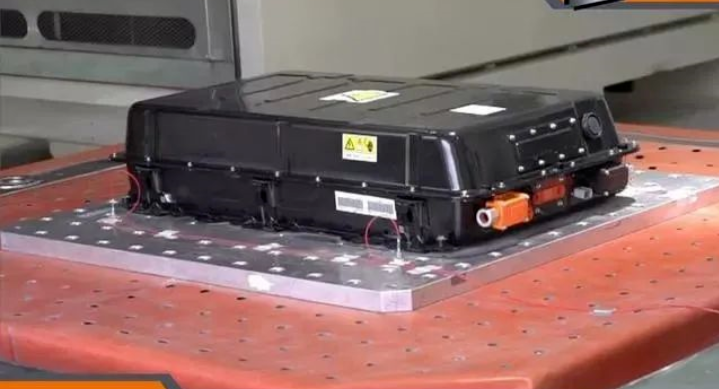
Tiny homes rarely have a utility room, so the pack must live in a hallway cupboard, under a staircase, or in a purpose-built floor cavity. Three form factors do the work. A 51.2 V rack module of 100 Ah is about 440 millimetres wide and fits a standard shallow cupboard in stacks of three or four. An all-in-one unit with a built-in inverter and a 3.5 kWh stack is the simplest installation but limits future expansion. A custom aluminium case sized to a known gap, with the cells mounted vertically in a foam-bonded block, is what most serious tiny-home builds use, because it uses the exact volume available. Whatever the shape, leave 100 millimetres of clearance at the back for airflow and keep the case vented to outside air rather than into the living space.
Charging From a Small Solar Array
A 30 kWh pack needs a correspondingly sized array. Under the same roof area, a 6 kW array with a 5 kW inverter is typical for a 20 to 30 kWh-per-day house and fits comfortably on a modest roof pitch. Charge control matters more than peak sun: set absorbing voltage to 56.0 to 58.4 V for a 16-cell LiFePO4 string, hold absorption for no more than two hours, and use a temperature-compensated charge controller that derates above 45 degrees or below 0 degrees at the battery. Because a tiny home’s roof is small, most owners add a portable 400 W panel used on a deck in winter. That trickle needs a charge controller that can handle a fractional array without oscillating, which cheap ones sometimes cannot.
Placement, Wiring and Interior Heat
Battery placement in a small dwelling is a safety as much as a comfort question. Do not place a pack directly beneath a hob or a fireplace where radiant heat raises its temperature, and do not install it in a bathroom or a cupboard with a water pipe running through it, because a leak and a pack are a bad combination. Keep dc cable runs short with properly sized cable: 70 mm squared for 100 A is not excessive. Add a dc residual current device if your jurisdiction requires one, a class-T fuse at the pack positive, and a properly rated isolator near the inverter.
Codes, Certification and What to Require
Installed indoor storage should carry a UL 1970 or UL 9540A rating in North America, and IEC 62619 certification for the cells with UN38.3 transport test reporting. Your inverter should be on the relevant approved product list for the storage you install, because an unlisted combination fails insurance inspection in many jurisdictions. Installers should follow the electric code for dc circuits, add a labeled disconnect, and keep a multipurpose dry chemical extinguisher nearby. A compliant installation is also easier when the pack has an internal list of components, and the U.S. Department of Energy publishes guidance on residential storage safety and interconnection. Ask the supplier for the certificate number, not just the claim. The U.S. Department of Energy publishes residential storage safety and interconnection guidance that installers should follow.
Layout Comparison for a 38 kWh Bank
| Configuration | Footprint | Usable kWh | Expandable |
|---|---|---|---|
| Four 100 Ah rack modules | 0.28 m² floor area | 34 | Yes, in racks |
| All-in-one 5 kWh stack | 0.10 m² floor area | 4.5 | Limited |
| Custom under-stair case | 0.16 m² floor area | 32 | No, single string |
| Two 200 Ah wall boxes | 0.22 m² wall face | 36 | Yes, paired |
Payback and Operating Cost
Tiny homes frequently pay back faster than conventional houses because the roof is small but the demand charge profile is sharp. In a market with a flat 0.18 USD per kilowatt-hour tariff and a 0.10 USD per kilowatt-hour feed-in, arbitraging a 0.6 spread over 10 kWh a day returns roughly 600 USD of spread annually against a pack costing 7000 USD, which is a decade of pure arbitrage before equipment life is counted. Add demand-charge reduction, which can be the larger number on commercial rooftops, and the case strengthens. The IEA tracks storage cost curves that put installed residential capacity at a few hundred USD per kilowatt-hour in most markets, and BloombergNEF publishes the annual price benchmark used for those figures. Treat payback as a secondary benefit: the primary one is that a tiny home stops depending on a generator.
People Also Ask
How big a battery does a tiny home need? For a 5 kWp array and 8 to 10 kWh daily use, a 15 to 20 kWh pack covers two dark days. If you cook electrically and heat with power, budget 30 to 40 kWh and check the inverter current first.
Can the battery go behind a wall in a tiny house? Only if it is a listed indoor-rated unit with a vented enclosure and accessible disconnection. Most DIY cases should stay in a cupboard with clearance, never inside a sealed wall cavity.
What happens if the pack fails? A LiFePO4 pack with a working BMS shuts down at its low-voltage cutoff rather than failing dangerously, and a properly fused pack protects the dc side. Have the inverter’s fault code read before replacing anything.
Written by Karl at China Battery Technology. Request a quote.